
Alkaline Water Filters: What They Do, What They Don’t, and What the Evidence Says

“Alkaline” is one of the most searched words in the water aisle, and one of the least clearly explained. Bottles promise it, pitchers claim to make it, and expensive countertop machines are sold almost entirely on it. This guide takes the word apart: what alkaline water actually is, the handful of ways it is produced, what the evidence honestly supports — stated carefully, because the claims in this category often run well ahead of it — and the one fact that matters most if you arrived here from a fridge filter page: a standard carbon refrigerator filter does not meaningfully raise the pH of your water, and it is not sold as an alkaline filter. If alkaline water is what you want, it is a different product category — one we do not sell — and this page will tell you plainly what that category involves.
What “Alkaline” Actually Means
Alkalinity is a position on the pH scale, which runs from 0 (strongly acidic) through 7 (neutral) to 14 (strongly alkaline). Plain water sits near neutral. Alkaline water is simply water with a pH above 7 — commonly marketed somewhere in the 8 to 9.5 range. Nothing about that definition is exotic: pH is basic chemistry, and water supplies vary naturally in pH depending on the minerals they have picked up along the way. Water that has run through limestone country, for instance, arrives mineral-rich and mildly alkaline without any machine being involved.
Two clarifications worth making early. First, pH is a property, not a filtration result — raising pH and removing contaminants are different jobs done by different means. Second, “alkaline” and “mineralised” overlap heavily in marketing but are not the same thing: most products that raise pH do so by adding or concentrating minerals, and it is the minerals doing the work.
How Alkaline Water Is Usually Made
There are a few common routes, all described here in general terms:
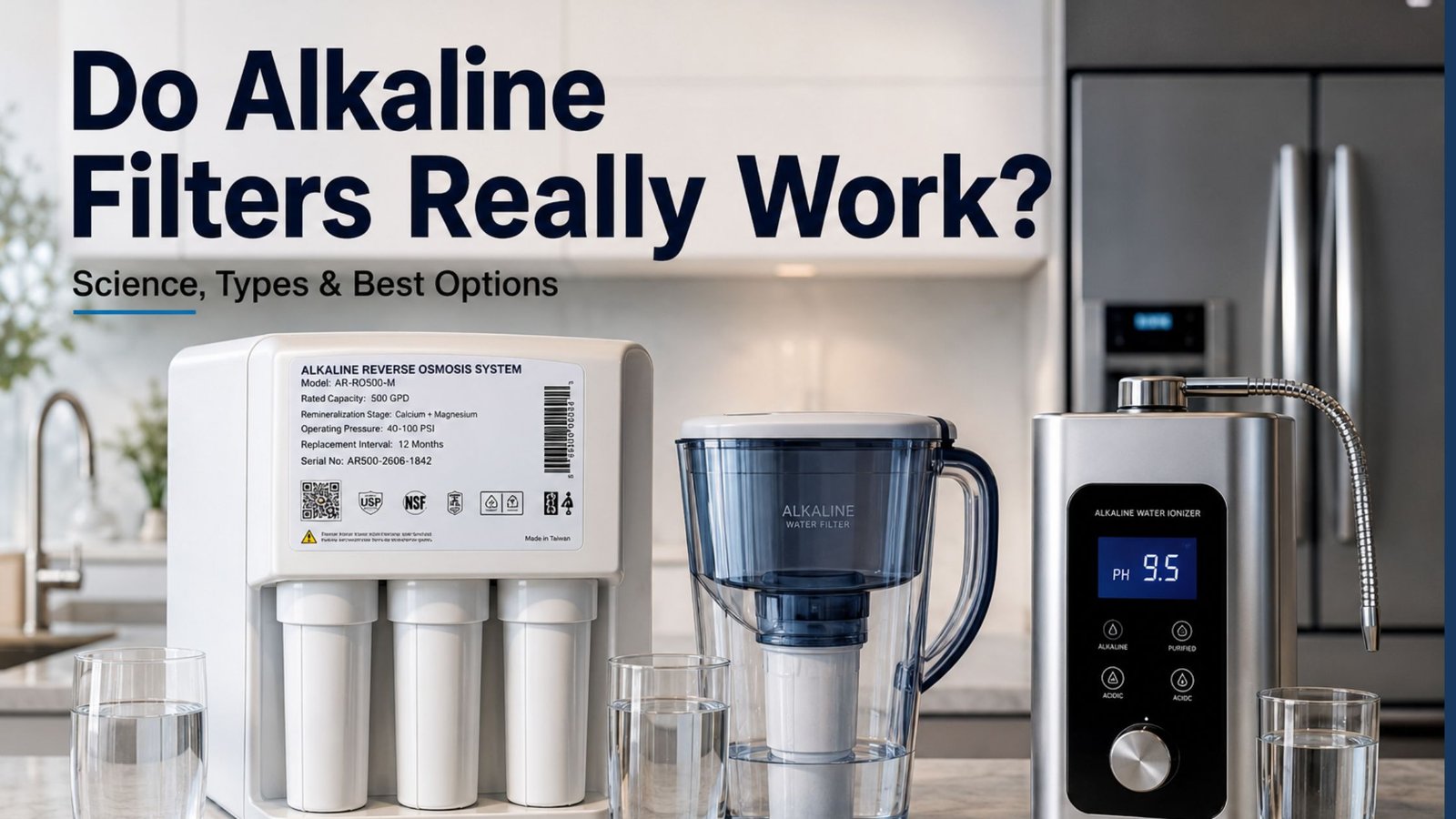
Electric ionizers. Countertop or under-sink machines that use electrolysis to split incoming water into an alkaline stream and an acidic stream. These are the dedicated alkaline-water appliances, and they are the most expensive route.
Alkaline pitcher and dispenser cartridges. Some filter pitchers use cartridges containing mineral media — materials such as calcium- or magnesium-based compounds — that dissolve slightly into the water as it passes, nudging the pH upward while a carbon element handles taste and odour. The pH effect depends on the media, the source water, and how fresh the cartridge is.
Remineralisation stages on reverse osmosis systems. RO strips minerals and tends to leave water mildly acidic (see below), so some RO systems add a final mineral stage that puts some mineral content back and lifts the pH toward neutral or slightly above.
Naturally alkaline source water. No device at all — just geology, as described above.
What the Evidence Honestly Supports
This is the section where alkaline water is usually oversold, so here is the careful version. The strong health claims attached to alkaline water — that it meaningfully changes the body’s internal pH, prevents or treats disease, or delivers benefits beyond hydration — are not established by the current state of the evidence, which is the broad position reflected in mainstream scientific and medical commentary. The body’s blood pH is tightly regulated by the lungs and kidneys and is not meaningfully moved by the pH of drinking water in healthy people; stomach acid, which is far more acidic than any beverage is alkaline, neutralises much of what arrives in any case.
What is fairly said: drinking enough water matters, and if a mildly alkaline water tastes better to you and that taste helps you drink more of it, that is a real, if modest, benefit. Some people also prefer the taste of mineralised water generally. Those are legitimate reasons to choose a product — taste and habit are honest grounds for a purchase. Medical promises are not, and any seller making them should be asked for evidence, not testimonials. If you have a medical condition and a clinician has raised water pH with you specifically, that conversation outranks anything on this page.
The Key Fact for Fridge Filter Owners
Now the part that connects to our shelves. A standard refrigerator water filter is an activated carbon block. Its job is adsorption — capturing chlorine and the contaminants its certification names. It does not add minerals, does not ionise anything, and does not meaningfully change the pH of the water passing through it. A genuine EveryDrop cartridge, for example, is certified to NSF/ANSI Standards 42, 53 and 401 plus CSA B483.1 per its product page — standards about taste, odour and contaminant reduction, with nothing about alkalinity anywhere in them. If a listing suggests an ordinary carbon fridge cartridge will “alkalise” your water, that claim is not coming from its certification.
Reverse osmosis goes the other way: because an RO membrane strips out the dissolved minerals that buffer pH, RO water commonly comes out mildly below neutral. That is precisely why remineralisation stages exist. So the two most common home filtration methods sit on opposite sides of this question: carbon leaves pH essentially where it found it, and RO tends to lower it slightly.
| Method | Effect on pH | Effect on taste |
|---|---|---|
| Standard carbon filter (fridge, pitcher, under-sink) | Essentially unchanged — no meaningful rise | Improves taste and odour by reducing chlorine; the genuine certified job |
| RO (reverse osmosis) | Tends to drop slightly — minerals that buffer pH are stripped out | Very neutral, flat to some palates; remineralisation stages exist to counter this |
| RO + remineralisation stage | Brought back toward neutral or slightly above | Mineral taste partially restored |
| Alkaline pitcher cartridge (mineral media) | Raised modestly, depending on media, source water and cartridge age | Mineral character added; varies as the media exhausts |
| Electric ionizer | Raised (or lowered) by electrolysis, user-selectable on many models | Depends on the setting chosen |
| Naturally alkaline source water | Already above 7 from geology | Mineral taste from the source itself |
Where This Fits the Wider Picture
Alkalising is one goal among many, and it is not a contaminant-reduction claim. If your actual concern is chlorine taste, lead, or pharmaceuticals, the answer is a certified carbon cartridge chosen by its NSF/ANSI list — our map of water filtration systems for homes lays out which machine solves which problem, and our explainer on water filter vs purifier covers what the certification language really means. If your goal is specifically pH, treat it as its own purchase: an ionizer or a mineral-media cartridge from a seller in that category, judged on stated pH performance rather than on health promises.
What We Sell — Stated Straight
We sell genuine refrigerator water filter cartridges — EveryDrop, Samsung and Frigidaire — certified for the contaminant lists on their own product pages. None of them is an alkaline filter, none of them raises pH, and we will not describe them as if they do. Every genuine EveryDrop cartridge here is $39.99 one-time with free US shipping on any order amount, against the official store’s $59.99 one-time or $48 by subscription; Filters Fast ships free only at $99+ and Discount Filter at $70+. Orders are processed within 1–2 business days, delivered in 3–5 business days via USPS, and unopened filters return within 30 days, free, with a prepaid label. That buys you certified filtration for the water your fridge dispenses — honestly labelled, which in this particular corner of the water aisle is worth insisting on wherever you shop.
Frequently Asked Questions
Does a refrigerator water filter make water alkaline? No. A standard fridge cartridge is activated carbon; it reduces chlorine and its certified contaminants and leaves pH essentially unchanged. It is not an alkaline filter and carries no pH claim in its certification.
Does reverse osmosis water have a lower pH? Generally, yes — slightly. RO strips the dissolved minerals that buffer pH, so the output commonly sits a little below neutral. It is harmless in itself, and some systems add a remineralisation stage for taste and to lift pH back up.
Is alkaline water healthier than regular water? The strong health claims made for alkaline water are not established by current evidence. Staying hydrated matters; the pH of the water itself has not been shown to deliver the benefits commonly advertised. Anyone with a specific medical concern should follow their clinician’s advice, not marketing.
How is alkaline water actually made? Mainly three ways: electric ionizers that split water by electrolysis, pitcher or dispenser cartridges with mineral media that dissolve slightly into the water, and remineralisation stages added to RO systems. Some source water is naturally alkaline from geology, with no device involved.
What pH is alkaline water usually sold at? Commonly somewhere around 8 to 9.5 — above the neutral 7, but the exact figure varies by product and source water. Treat any specific number as the seller’s stated figure for that product, not a standard.
If I want alkaline water, what should I buy? A product from the alkaline category itself — an ionizer or a mineral-media cartridge — from a seller who states its pH performance plainly and skips the medical promises. We do not sell alkaline products; our cartridges are certified fridge filters, sold for filtration.