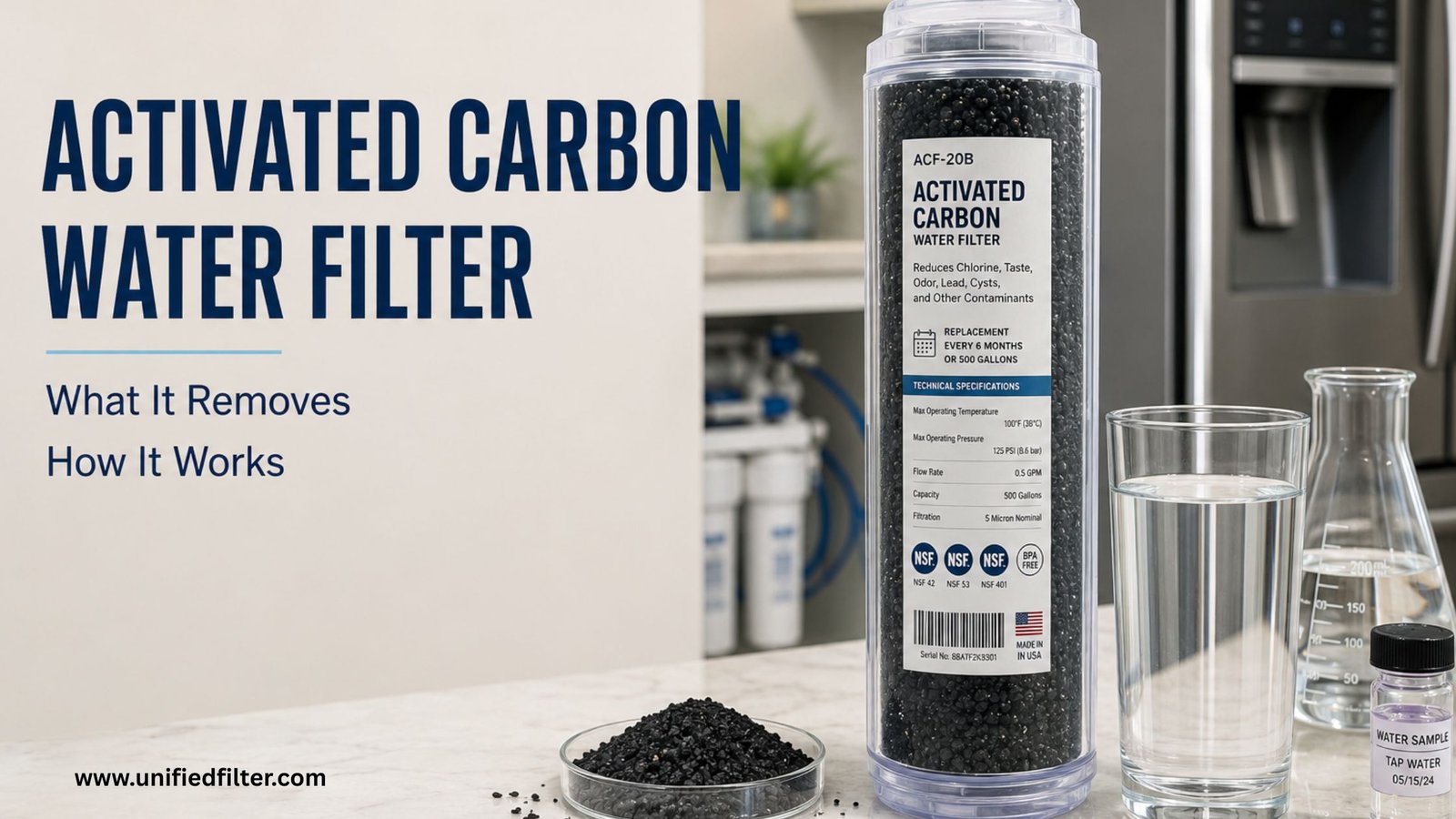

Open almost any home water filter — the cartridge in your fridge, a pitcher, an under-sink unit — and you will find the same black material doing the work of activated carbon filtration. It is the most widely used filtration medium in the home, and also the most loosely described. “Carbon filter” gets printed on boxes as if it were a performance guarantee, when it is really just the name of an ingredient. This guide explains the ingredient properly: what activation does to carbon, how adsorption actually captures contaminants, what carbon is genuinely good at, what it cannot do, its two forms — and why certification still decides what any specific filter is proven to do.
What “Activated” Actually Means
Carbon starts life as a carbon-rich material — coconut shell, coal or wood are the usual sources. Activation is a treatment, typically with heat and steam, that etches the material with a labyrinth of microscopic pores. The result is a substance that is almost all surface: the internal surface area packed into a small amount of activated carbon is enormous, far beyond the unactivated material.
That surface is the whole point. Filtration by activated carbon happens on surfaces, molecule by molecule, so a medium that is nearly all surface is a medium with an enormous capacity to interact with the water passing through it.
Adsorption: Sticking, Not Soaking
The mechanism is called adsorption — with a d — not absorption, the soaking-up a sponge does. In adsorption, contaminants in the water are attracted to the carbon’s surface and held there as the water flows past. The water moves on; the captured compounds stay stuck to the pore walls.
This explains both carbon’s strengths and its limits. Compounds that are chemically attracted to carbon’s surface — chlorine is the classic example, along with the organic compounds behind most taste and odour complaints — are captured reliably. Substances with little attraction to that surface pass through barely affected. Carbon is not a sieve that catches everything smaller than a hole; it is a surface that holds what sticks to it. Everything else in this guide follows from that sentence.
What Do Carbon Filters Remove From Water?
It is excellent at chlorine — the single biggest reason tap water tastes like a swimming pool — and at the broad family of taste and odour compounds. Certified carbon cartridges go well beyond that baseline: the genuine EveryDrop Filter 1, the EDR1RXD1, is a carbon block cartridge certified to CSA B483.1 and NSF/ANSI Standards 42, 53 and 401; its product page’s specification lists it as certified to reduce up to 70 contaminants — including lead, pesticides and pharmaceuticals — and 99% of microplastics. That is what a well-made carbon block, tested and certified claim by claim, can do. Our guide to what a water filter for your fridge does maps those certifications onto the cartridge families.
What Carbon Does Not Do
The honest limits follow from the mechanism. Carbon does not meaningfully reduce TDS (total dissolved solids) — dissolved minerals are not held by its surface. It does not soften water: the calcium and magnesium of hardness pass straight through, because softening is ion exchange, not adsorption. And while carbon cartridges can carry certified reductions for specific named contaminants, carbon makes no general certified claim against bacteria and viruses — a fridge cartridge is not a purifier, whatever the listing language implies. Match the problem to the method: TDS belongs to reverse osmosis, hardness to a softener, microbial safety to certified purification.
The Two Forms: GAC vs Carbon Block
Activated carbon reaches your glass in two main forms, and the difference matters:
| Granular activated carbon (GAC) | Carbon block | |
|---|---|---|
| Form | Loose granules of activated carbon in a cartridge or tank | Carbon compressed with a binder into a solid block |
| Flow path | Water winds between granules; some channelling is possible | Water is forced through the block’s fine pore structure |
| Filtration fineness | Set by granule size and contact time | Generally finer and more uniform — the block also strains particles physically |
| Common home | Pitchers, faucet mounts, whole-house carbon tanks | Refrigerator cartridges and under-sink units |
| Example | The carbon in a typical pitcher cartridge | The EDR1RXD1’s product page lists its media as Carbon Block / Activated Carbon Block |
Carbon block’s compressed structure is why fridge cartridges use it: in a small cartridge with water passing at mains pressure, the block gives both adsorption surface and consistent physical straining in a sealed unit. GAC’s looser structure suits big volumes at lower pressure — a whole-house tank, or a jug filtering by gravity.
Why Certification Still Decides
Here is the lesson the whole category keeps relearning: the medium is not the claim. Two cartridges can both be “carbon block” and have completely different certified reduction lists — or none at all. Our PFAS water filter guide gives the sharpest example: a cartridge can be certified under an emerging-contaminants standard for some compounds and still carry no PFAS claim, because certifications are granted per product, per contaminant. The discipline that follows is simple: read the specific cartridge’s certification list — the standards it names and the reductions it claims — rather than trusting the ingredient on the box. Carbon is the engine; certification is the test result.
Exhaustion: Why Change Intervals Exist
Adsorption has a budget. Every site on the carbon’s surface that captures a contaminant is a site that cannot capture another, and as the surface fills, capture falls away — gradually, invisibly, while the water still looks fine. That is breakthrough, and it is why filters have rated lives rather than working until they clog: the EDR1RXD1 is rated at 6 months and 200 gallons on its product page, and its certified reductions describe a cartridge inside that life. Changing on schedule is not a manufacturer’s upsell; it is the maintenance half of how adsorption works. A new cartridge also needs its flush — about 4 gallons per the Filter 1 page — to clear carbon fines and air.
The genuine EDR1RXD1 is $39.99 one-time at Discounted Filter Store, with free US shipping on any order amount — against $59.99 one-time at the official EveryDrop store, or $48 only with a subscription, with Filters Fast shipping free only at $99+ and Discount Filter at $70+. Orders are processed within 1–2 business days and delivered in 3–5 business days via USPS, and unopened filters return within 30 days, free, with a prepaid label.
Frequently Asked Questions
What is the difference between adsorption and absorption? Absorption is soaking into a material’s bulk, like water into a sponge. Adsorption — carbon’s method — is compounds sticking to a material’s surface. Activated carbon works because activation gives it an enormous internal surface for contaminants to stick to.
Does an activated carbon filter remove everything? No. Carbon excels at chlorine, taste and odour, and — on certified cartridges — named chemicals such as lead, pesticides and pharmaceuticals. It does not meaningfully reduce TDS, does not soften hard water, and carries no general certified claim against bacteria and viruses.
Which is better, granular carbon (GAC) or carbon block? They suit different jobs. Carbon block’s compressed, fine structure gives consistent filtration in small pressurised cartridges — it is the form fridge filters use. GAC suits large volumes at lower pressure, like pitchers and whole-house tanks. “Better” depends on the housing and the certification behind it.
If a filter is carbon, is it automatically certified? No — and this is the most important point on the page. Carbon is a medium, not a claim. Certifications like NSF/ANSI 42, 53 and 401 attach to specific cartridges and specific contaminant reductions. Read the individual product’s list.
Why does my water taste bad again even though the filter still flows? Because adsorption exhausts gradually. As the carbon’s surface fills, capture falls away before flow does — taste returning is often the first sign the cartridge has reached the end of its rated life and is due for a change.
How long does an activated carbon fridge cartridge last? By its rating: the genuine EveryDrop Filter 1 is rated 6 months and 200 gallons on its product page. Change on that schedule — the certified reductions describe a cartridge within its rated life, not beyond it.