
“Water filtration” is one phrase covering at least six different machines that do very different jobs — and most disappointment in this category comes from buying one machine to do another machine’s job. A fridge filter will never soften hard water. A softener will never make water taste better. This guide is the honest map: the two families every system belongs to (point-of-use and point-of-entry), the three treatment methods underneath them, a side-by-side comparison, how households layer systems together, and how to choose by the problem you actually have. Where a section touches the one category we sell — refrigerator filters — we say so and use real figures from our own product pages; everything else is general terms, with each manufacturer’s documentation the final authority for any specific model.
Point-of-Use vs Point-of-Entry: The Two Families
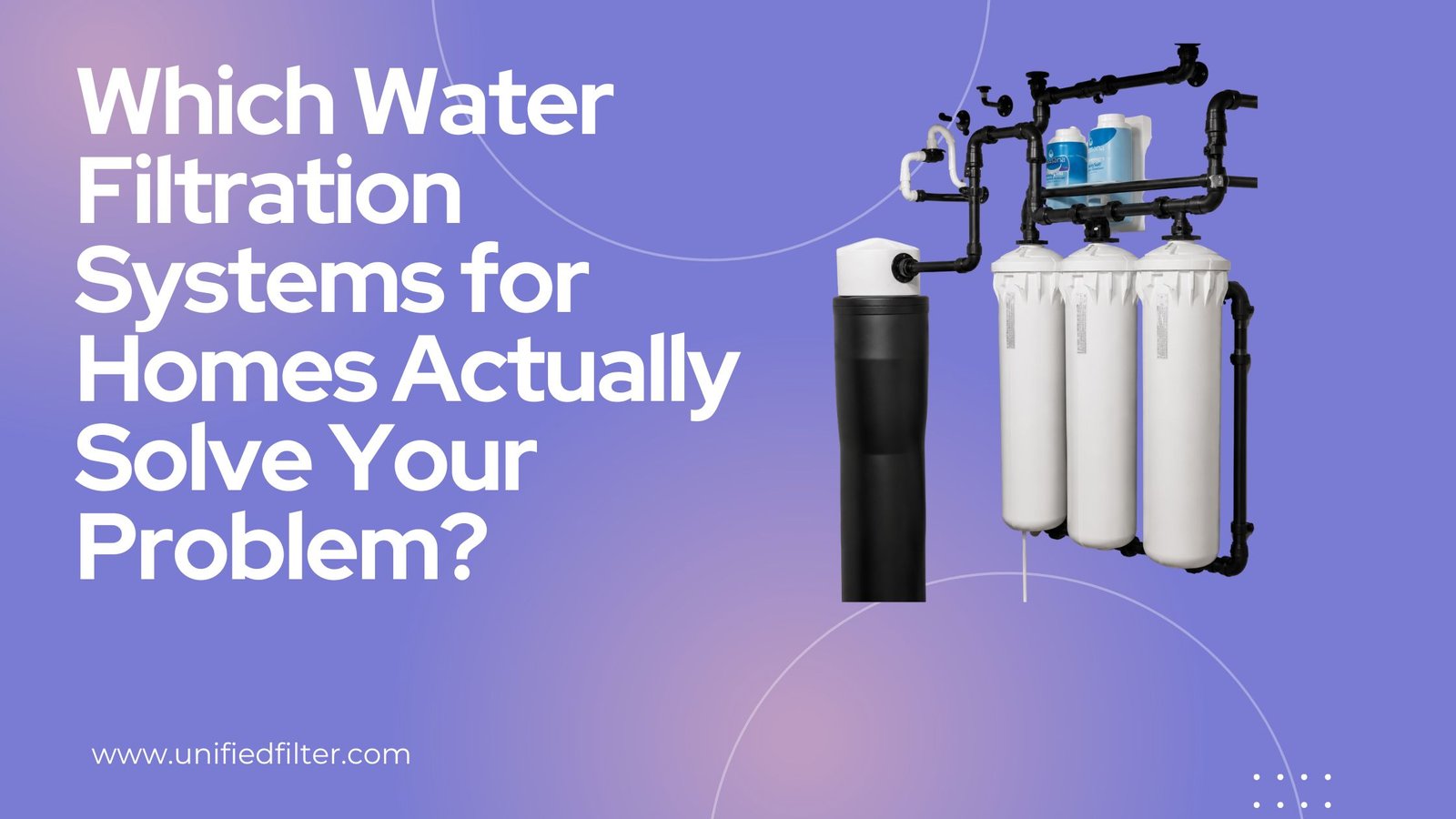
Every home water system sits in one of two places. Point-of-use (POU) systems treat water at one outlet, where you drink it: the filter inside your refrigerator, a countertop pitcher, a faucet-mount filter, or an under-sink unit feeding a dedicated tap. They are small, cheap to run, and treat only the water you consume — which is a small fraction of household water. Point-of-entry (POE) systems treat all the water entering the house, at the main line: whole-house sediment filters, whole-house carbon tanks, and water softeners. They protect plumbing and appliances as well as taps, cost more to install, and treat everything including showers and laundry whether it needs treating or not. Neither family is “better” — they answer different questions. Most homes that filter seriously end up with one of each, doing different jobs.
The Three Treatment Methods (and What Each Cannot Do)
Underneath the packaging, home filtration uses three main methods, and confusing them is the root of most bad purchases:
Carbon adsorption — water passes through activated carbon and contaminants stick to its surface. This is the method in fridge filters, pitchers, faucet mounts and most under-sink cartridges. It is excellent at chlorine taste and odour, and certified carbon cartridges go further — reducing lead, pesticides, pharmaceuticals and more, depending on the cartridge’s certification. Its honest limits: carbon does not soften water and does not meaningfully reduce TDS (total dissolved solids). The calcium and magnesium that make water “hard” pass straight through, and so does the mineral content a TDS meter reads.
Reverse osmosis (RO) — water is pushed through a membrane fine enough to strip out dissolved solids. RO genuinely reduces TDS, along with a broad range of dissolved contaminants. Its honest costs: it rejects a portion of incoming water as wastewater for every litre produced, it strips beneficial minerals along with the contaminants (which is why some systems add a remineralisation stage), and it needs pressure, a storage tank and membrane changes. Under-sink RO is point-of-use; whole-house RO exists but is uncommon.
Softening — an ion-exchange softener swaps calcium and magnesium ions for sodium or potassium ions. That is the whole job: it addresses hardness only. A softener does not filter — it removes nothing you taste, does not meaningfully reduce chlorine, lead or TDS, and exists to protect pipes, heaters and appliances from scale. If your complaint is taste, a softener is the wrong machine; if your complaint is scale crusting a water heater, carbon is the wrong machine.
The Main System Types, Compared
| System type | Family | Where it sits | What it treats | Maintenance rhythm (general) |
|---|---|---|---|---|
| Fridge filter | Point-of-use | Inside the refrigerator | Chlorine taste/odour; certified models also lead, pesticides, pharmaceuticals | Cartridge swap ~every 6 months |
| Filter pitcher | Point-of-use | Countertop / fridge shelf | Taste and odour; some models certified for more — check the exact model | Small cartridges, changed frequently |
| Faucet mount | Point-of-use | On the kitchen tap | Taste and odour at that tap | Small cartridges, changed frequently |
| Under-sink filter (carbon) | Point-of-use | Under the kitchen sink | Taste/odour and certified contaminants at one tap | Cartridge changes on a months-scale cycle |
| Under-sink reverse osmosis | Point-of-use | Under the kitchen sink | TDS and a broad range of dissolved contaminants | Pre-filters periodically; membrane on a longer cycle |
| Whole-house sediment | Point-of-entry | Main line, where water enters | Sand, grit, rust and particles | Cartridge or media changes on a months-scale cycle |
| Whole-house carbon | Point-of-entry | Main line | Chlorine taste/odour throughout the house | Media replacement on a long cycle |
| Water softener | Point-of-entry | Main line | Hardness (calcium/magnesium) only | Salt top-ups regularly; resin lasts years |
No prices are listed for the systems we do not sell — costs vary too widely by model and installation to quote honestly — but the pattern is consistent: point-of-use is cheaper to start and simpler to maintain; point-of-entry costs more up front and protects the whole house.
How Households Layer Systems
Because the methods do different jobs, real systems are usually combinations. The most common pairing: a whole-house sediment filter at the main line catching grit before it reaches anything, and a carbon fridge filter polishing taste and certified contaminants at the dispenser — protection outside, flavour inside. A softener joins the stack where hardness is severe, at the entry point so scale never forms in the heater — while drinking-water taste is still handled by carbon at the point of use, because softened water is not filtered water. RO usually sits under the kitchen sink as the final stage for drinking water specifically. The principle is simple: coarse problems early (sediment, hardness), fine problems late (taste, lead, pharmaceuticals).
Choose by the Problem, Not the Product
- “My water tastes like a swimming pool.” Chlorine taste and odour — carbon’s home turf. A fridge filter, pitcher or under-sink carbon cartridge solves it; our water filter for fridge guide covers the fridge route in depth.
- “I’m worried about lead.” You need a cartridge certified to NSF/ANSI Standard 53 for lead (or an RO system) — not any carbon filter, the certified one. The genuine EveryDrop Filter 1 we sell, the EDR1RXD1, is certified to NSF/ANSI Standards 42, 53 and 401 plus CSA B483.1 per its product page, and is certified to reduce lead, pesticides and pharmaceuticals among its contaminants — which is what certification is for.
- “White scale is killing my appliances.” Hardness — a softener’s job. No filter cartridge fixes it, whatever its box claims.
- “There’s grit and rust in the water.” Sediment — a point-of-entry sediment filter, so every tap benefits.
- “I want the lowest possible TDS.” Reverse osmosis, accepting the wastewater and mineral trade-offs knowingly.
Not sure which cartridge your fridge even takes before you plan the rest? Our what water filter do I need? finder settles that first step.
What We Sell, and What It Costs
We sell the point-of-use end of this map: refrigerator cartridges. The genuine EveryDrop Filter 1, EDR1RXD1, is rated for 6 months and 200 gallons per its product page, and every genuine EveryDrop cartridge here is $39.99 one-time with free US shipping on any order amount — against the official store’s $59.99 one-time (or $48 by subscription), Filters Fast’s free shipping starting at $99+, and Discount Filter’s at $70+. Orders are processed within 1–2 business days, delivered in 3–5 business days via USPS, and unopened filters return within 30 days, free, with a prepaid label. For whole-house, RO and softening equipment, buy from a specialist in that category — and use the map above to make sure the machine matches the problem before you pay for it.
Frequently Asked Questions
What is the difference between point-of-use and point-of-entry filtration? Point-of-use systems treat water at one outlet — a fridge dispenser, a pitcher, one tap. Point-of-entry systems treat all water where it enters the house. They solve different problems and are often combined.
Does a fridge filter or pitcher soften water or remove TDS? No. Carbon adsorption does not soften water and does not meaningfully reduce TDS. Softening needs an ion-exchange softener; TDS reduction needs reverse osmosis. A carbon cartridge’s job is taste, odour and its certified contaminants.
Does reverse osmosis waste water and remove minerals? Yes on both counts, as commonly documented for RO systems: a portion of incoming water is rejected as wastewater, and the membrane strips dissolved minerals along with contaminants. Some systems add remineralisation; whether that matters to you is a preference, but the trade-off itself is real.
What does a water softener actually do? It swaps the calcium and magnesium that cause hardness for sodium or potassium ions. It protects plumbing and appliances from scale — and nothing else. It does not filter taste, chlorine or contaminants.
Which system do I need for lead? A cartridge certified to NSF/ANSI Standard 53 for lead reduction, or a reverse-osmosis system. The genuine EveryDrop Filter 1 is certified to Standards 42, 53 and 401 per its product page — always check the specific standard list for the exact cartridge you buy.
Can I combine a whole-house filter with a fridge filter? Yes — it is the most common layering: whole-house sediment filtration at the entry point for protection, and a carbon fridge filter at the dispenser for taste and certified contaminant reduction. Each handles the job the other cannot.