
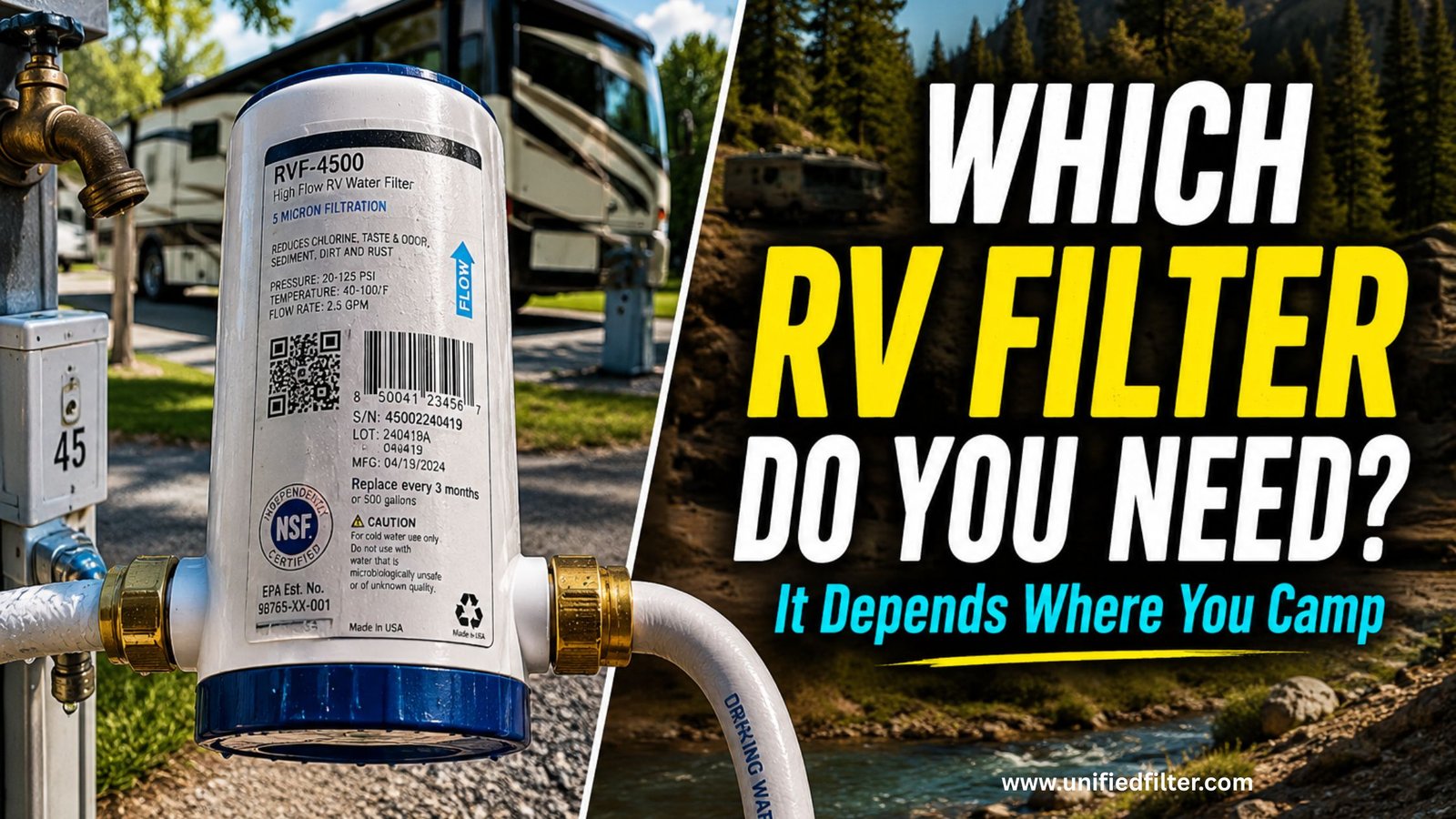

A house drinks from the same water supply every day of its life. An RV drinks from a different one every time it parks. One week it is a city campground with treated municipal water; the next it is a rural site on a private well, a fairground hookup that has sat unused all winter, or a fill station whose last user you know nothing about. That variability is the whole reason RV water filtration exists in its own shape. This guide explains how that shape works: why RVers filter, the two layers most rigs end up with, the upkeep that keeps them honest, and the question we get most — what about the fridge? One disclosure up front: we sell internal refrigerator cartridges for household fridges, not RV inline filters. This page is an explanation, not a sales page for a part we do not stock.
Why RV Water Needs Filtering at All
Three features of RV life make filtration matter more on the road than in a house. First, the source changes constantly — each new hookup is water you have never tasted, from pipes you have never seen, and quality genuinely varies from site to site. Second, sediment is a real traveller’s problem: campground and well systems can carry sand, rust and grit that a home supply rarely delivers, and that grit reaches your pump and water heater. Third, the water then sits in your own tank and lines, sometimes for days in the heat, which does nothing for taste. Most RV filtration is therefore aimed at the everyday complaints — sediment, chlorine taste and odour — rather than at exotic contaminants.
Layer 1: The Inline Filter on the Hose
The most common RV filter is one you may already picture: a short cylindrical inline filter that screws onto the fresh-water hose between the campground tap and the RV’s city-water inlet. Every litre entering the rig passes through it, so it protects the whole plumbing system, not just your drinking glass. Filters of this type are generally carbon-based (often granular activated carbon, sometimes with additional sediment media), and their documented job is the broad one: reducing sediment, chlorine taste and odour from whatever the site supplies.
Its position is its strength and its limit. Because it treats all incoming water at hose flow rates, it is a generalist — good at making an unknown supply pleasanter and cleaner-feeling. It is the layer most RVers start with, and for many it is the only layer they ever fit.
Layer 2: A Point-of-Use Filter for Drinking Water
The second layer, where fitted, sits at the tap you actually drink from. Some RVs have an internal filtration system under the sink feeding a dedicated drinking tap; others rely on a simple countertop pitcher. The logic mirrors the household pattern in our guide to water filtration systems for homes: coarse, whole-supply treatment outside; finer, targeted treatment at the point where you drink. A point-of-use stage can carry a more specific specification than a hose filter working at full flow — but what it actually does is decided by its own certification and specification, not by its position in the rig.
| Layer | Where it sits | What it protects | Its main jobs | Change rhythm (general) |
|---|---|---|---|---|
| Inline hose filter | On the hose, between the site tap and the RV inlet | The whole rig — pump, heater, every faucet | Sediment, chlorine taste and odour from an unknown supply | Typically rated by season or months of use — follow its own rating; many owners replace each season |
| Internal / point-of-use filter | Under the sink or at a drinking tap | The glass you drink from | Finer, targeted treatment per its own cartridge specification | Per the cartridge’s rated life in its documentation |
| Your fresh-water tank (not a filter) | Onboard storage | Nothing — it stores what you filled | — | Sanitise on the schedule your RV manual sets; stored water quality starts with what you put in |
Flush, Change and Winterise: The Discipline
RV filters live harder lives than household ones, and three habits keep them honest. Flush a new inline filter before connecting it to the rig — run water through it onto the ground first, as its instructions direct, so loose carbon fines go to the grass and not into your tank. Replace on the filter’s own rating, not on how the water tastes — a carbon filter past its life keeps passing water while capturing less and less, and a season is a long time in filter terms. Winterise properly: filters hold water, water freezes, and a frozen filter or housing can crack — the general practice is to remove filters before winter storage and drain the system, following your RV manufacturer’s winterisation procedure, which is the final authority for your rig. A filter removed for winter is generally a filter replaced in spring rather than reinstalled.
What About the Fridge in Your RV?
This is where our shelf and your rig usually part company. Most RV refrigerators are absorption fridges — they run on propane and electric, have no water dispenser and no ice maker plumbed to a supply, and have no water filter at all. There is nothing to change because there is nothing fitted. At the other end of the market, some large or high-end RVs fit residential-style household refrigerators, with a dispenser and an internal cartridge. Those take household cartridges, identified the same way as at home: by the label on the cartridge you remove, using the label-first method in our what water filter do I need? finder.
So the rule is simple and we state it plainly: do not assume an RV fridge takes any cartridge — most take none, and the ones that do take the household cartridge their label names. We will not claim a general RV fit for the filters we sell, because there isn’t one. If your rig has a residential fridge, read its cartridge’s label; if it matches a household part number we stock, that is simply a household purchase. If yours is an absorption unit, your filtration story is the hose and the tap, as the layers above describe.
Frequently Asked Questions
Do I really need a filter on my RV’s water hose? It is the most common and most practical single step: an inline filter on the hose treats every litre entering the rig, catching sediment and improving taste from supplies that change at every stop. Whether you add a second, drinking-water layer depends on how variable your sites are and how much you care about the last stage before the glass.
How often should an RV inline filter be changed? On its own rating — these filters are commonly rated by months or a season of use rather than by gallons. Many owners simply fit a fresh one each season. A filter that has sat wet in storage, or frozen over winter, should be replaced rather than reused.
Can I drink campground water after an inline filter? An inline filter’s job is sediment and taste/odour improvement; it is not, by itself, a guarantee about any specific supply. If a site advises against drinking its water, follow that advice — filtration improves ordinary supplies, it does not certify a doubtful one.
Does my RV fridge have a water filter? Probably not. Most RV absorption fridges have no dispenser and no filter. Residential-style fridges fitted in some larger RVs do take household cartridges — the label on the existing cartridge or the fridge manual settles which situation you are in.
Will one of your cartridges fit my RV? Only in the residential-fridge case, and only if the cartridge already in that fridge carries a household part number we stock. We sell internal cartridges for household fridges; we do not sell RV inline hose filters, and we do not claim a general RV fit.
What should I do with the filter when I winterise? Remove it before storage, drain the system per your RV manufacturer’s procedure, and plan on a fresh filter in spring. Filters hold water, and a frozen filter or housing can crack — winterisation is part of filter ownership on the road.