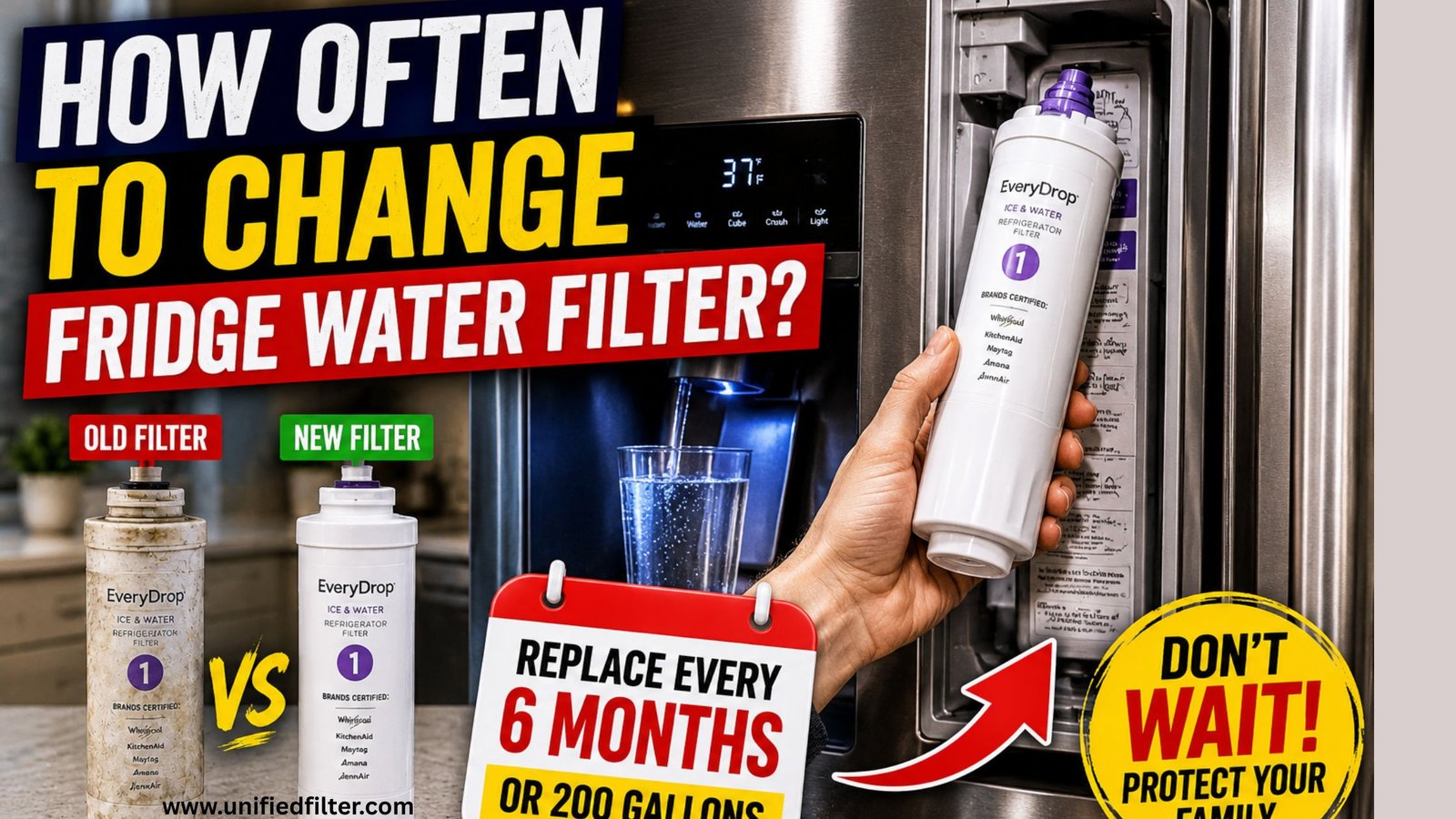

The short answer: change your refrigerator water filter about every 6 months. That is the interval printed on nearly every genuine cartridge sold today, and it is the number your fridge’s indicator light is counting towards. If you only came here for the answer, you have it — set a reminder for six months from your last change and you will be right almost every time.
But “about” is doing some work in that sentence. Each filter carries its own rating in gallons as well as months, heavy-use households genuinely wear a cartridge out sooner, and a filter can be finished before the calendar says so — or, in a low-use second fridge, still be working at month seven. This page gives you the exact ratings for the filters we sell, explains which limit actually matters, and lists the signs that mean “change it now, whatever the date says.”
The Per-Filter Ratings, Straight From the Product Pages
Every cartridge has two limits: a gallon rating and a time rating. Whichever you reach first ends the filter’s life. Here are the ratings for the main filters in our range, taken from their own product pages:
| Filter | Part number | Rated life | Gallon rating |
|---|---|---|---|
| EveryDrop Filter 1 | EDR1RXD1 | 6 months | 200 gallons |
| EveryDrop Filter 2 | EDR2RXD1 | About 6 months | About 200 gallons |
| EveryDrop Filter 3 | EDR3RXD1 | 6 months | 200 gallons |
| EveryDrop Filter 4 | EDR4RXD1 | 6 months | See product page |
| EveryDrop Filter 5 | EDR5RXD1 | About 6 months | About 240 gallons |
| EveryDrop Filter A | EDRARXD1 | About 6 months | 200–250 gallons |
| Samsung HAF-CIN (round) | DA29-00020B | 6 months | 300 gallons |
| Samsung HAF-QIN (square) | DA97-17376B | 6 months | 300 gallons |
| Frigidaire PurePour PWF-1 | FPPWFU01 | 3–6 months | 125 gallons |
Two patterns stand out. First, the calendar limit barely moves — six months is the industry rhythm, because carbon media ages in contact with water whether you drink a lot or a little. Second, the gallon ratings vary more than people expect: the Frigidaire PWF-1 is rated at just 125 gallons with a 3–6 month window, while Samsung’s cartridges are rated to 300 gallons. The full EveryDrop range is mapped in our guide to EveryDrop refrigerator water filters.
Gallons or Calendar: Which Limit Hits First?
Run the rough maths on a typical household. A family filling glasses, bottles, the kettle and the ice maker can easily draw 1–2 gallons a day through the fridge. At that pace, a 200-gallon cartridge reaches its gallon rating in roughly four to six months — close to the calendar limit, which is exactly why the two numbers are paired. A single-person household drawing a few glasses a day might only reach 60–80 gallons in six months; for them the calendar is the binding limit, because the carbon has been sitting wet for half a year regardless.
The practical rule: track whichever comes first, and use the calendar as your default. Nobody meters their dispenser, so the date is the limit you can actually manage — write the install date on the cartridge, or set a phone reminder for six months out.
One more thing: your fridge’s indicator light is a timer (on some models a rough usage counter), not a water-quality sensor. It turns red at six months whether the filter is exhausted or fine — a useful reminder, but not the judge. The signs below are the judge.
Five Signs Your Filter Is Already Overdue
A spent cartridge rarely announces itself all at once. It fades. Watch for:
- The dispenser stream thins. A healthy filter pours at a steady pace; a clogging one slows to a dribble and takes twice as long to fill a glass. Flow loss is usually the first physical sign.
- Chlorine taste or smell creeps back. The carbon’s first job is chlorine taste and odour — and the first thing it stops doing when saturated. If your water starts tasting like the tap again, the media is full.
- Ice shrinks, hollows or clouds. Ice makers notice a tired filter early: smaller cubes, hollow centres, white cloudiness, or an off taste in drinks the ice melts into.
- The light has been red for weeks. Obvious, but the most ignored. A red light you keep meaning to deal with is a filter running on empty.
- It has simply been more than six months. Carbon saturates on schedule whether the water still tastes acceptable or not. Taste is a lagging indicator — certified contaminant reduction fades before flavour does.
If two or more of these are true, stop scheduling and change it today. The replacement job itself takes minutes; our per-filter walkthroughs, like the Filter 1 change guide, cover the exact steps for each housing.
Does Stretching a Filter Actually Hurt Anything?
Stretching a cartridge past its rating is not like stretching a light bulb. Three things happen as a filter over-runs:
- Certified reduction quietly stops. Ratings like the Filter 1’s NSF/ANSI 42, 53 and 401 certification apply within the rated life. Past it, the carbon may still pass water while no longer reducing contaminants to the certified level — the water looks identical, which is precisely the problem.
- Flow and pressure suffer. Trapped sediment builds until the dispenser slows and the ice maker under-fills — owners often blame the fridge for what is actually a $40 cartridge.
- Taste protection goes first. Clean-tasting water and neutral ice are the earliest casualties.
Set against that, the cost of changing on time is modest. We broke down the real numbers in our post on what a genuine fridge filter costs per year: at two changes a year, the genuine cartridge at $39.99 with free shipping works out far cheaper than most owners guess.
A Simple System That Keeps You On Schedule
Forgetfulness, not money, is why most filters run long. Three habits fix it:
- Date the cartridge. Marker on the label, install date, every time. When you pull an old filter and cannot read a date, that is your answer — change it and start the system now.
- Keep the spare in the kitchen. A multi-pack means the replacement is in a drawer when the light turns red, not in a cart you will forget to check out — and multi-packs lower the per-filter price across the range.
- Pair the change with a season. First week of January, first week of July — let the calendar do the remembering.
What a Genuine Replacement Costs Here
Every genuine EveryDrop cartridge — Filters 1, 2, 3, 4, 5 and Filter A — is $39.99 one-time at Discounted Filter Store, with free US shipping on any order amount; multi-packs bring the per-filter price down. The official EveryDrop store charges $59.99 one-time, or $48 only with a subscription. Filters Fast’s free shipping starts at $99+ and Discount Filter’s at $70+. Orders are processed within 1–2 business days and delivered in 3–5 business days via USPS — order when the light turns amber, or at month five, and the new cartridge is in the drawer before the old one is due. Unopened filters return free within 30 days on a prepaid label.
Frequently Asked Questions
How often should I change my fridge water filter? About every 6 months, or when you reach the cartridge’s gallon rating — whichever comes first. Filter 1, for example, is rated 6 months and 200 gallons; Samsung’s DA29-00020B is rated 6 months or 300 gallons.
Can I leave a filter in for a year if the water still tastes fine? We do not recommend it. Taste is a lagging indicator: certified contaminant reduction fades before flavour changes, and the carbon has been sitting in water for twice its rated life. Change at six months even if the water seems fine.
My filter light turned red but the water tastes normal. Is the light wrong? Neither is wrong — they measure different things. The light is a timer (roughly six months); your taste buds only notice chlorine breakthrough, which can lag behind the loss of other certified reductions. Treat the light as your reminder to change.
Does a big family need to change filters more often? Possibly, yes — because the gallon rating may arrive first. A household drawing 2 gallons a day reaches a 200-gallon rating in about 100 days. If your dispenser slows noticeably before six months, your usage, not the calendar, is setting your interval.
What happens if I never change the filter? Flow slows, ice quality drops, chlorine taste returns, and the cartridge stops reducing contaminants to its certified level while still passing water. The fridge keeps working; the filtration quietly does not.
When should I order the replacement? At month five, or when the indicator turns amber. With 1–2 business days’ processing and 3–5 business days’ USPS delivery here, ordering a week early guarantees the new genuine cartridge is in hand on change day.