
This page used to be the kind of “pitcher reviews” round-up the internet is full of — and we have rewritten it as something more useful: an honest buying guide. Full disclosure first, because it shapes everything below: we do not sell water filter pitchers, and we have not bench-tested any. We are a refrigerator-filter store. We have not ranked, scored or star-rated any pitcher model, and any site that has never touched the products it “reviews” is inventing its verdicts. What we can do honestly is explain what pitcher filters actually do, where they genuinely beat a fridge filter and where they lose, and the checks that matter before you buy any pitcher from anyone. If your fridge has a dispenser, our water filter for fridge guide covers the built-in alternative, and our genuine fridge filter cost-per-year breakdown shows the running-cost maths for that side of the comparison.
What a Pitcher Filter Actually Does
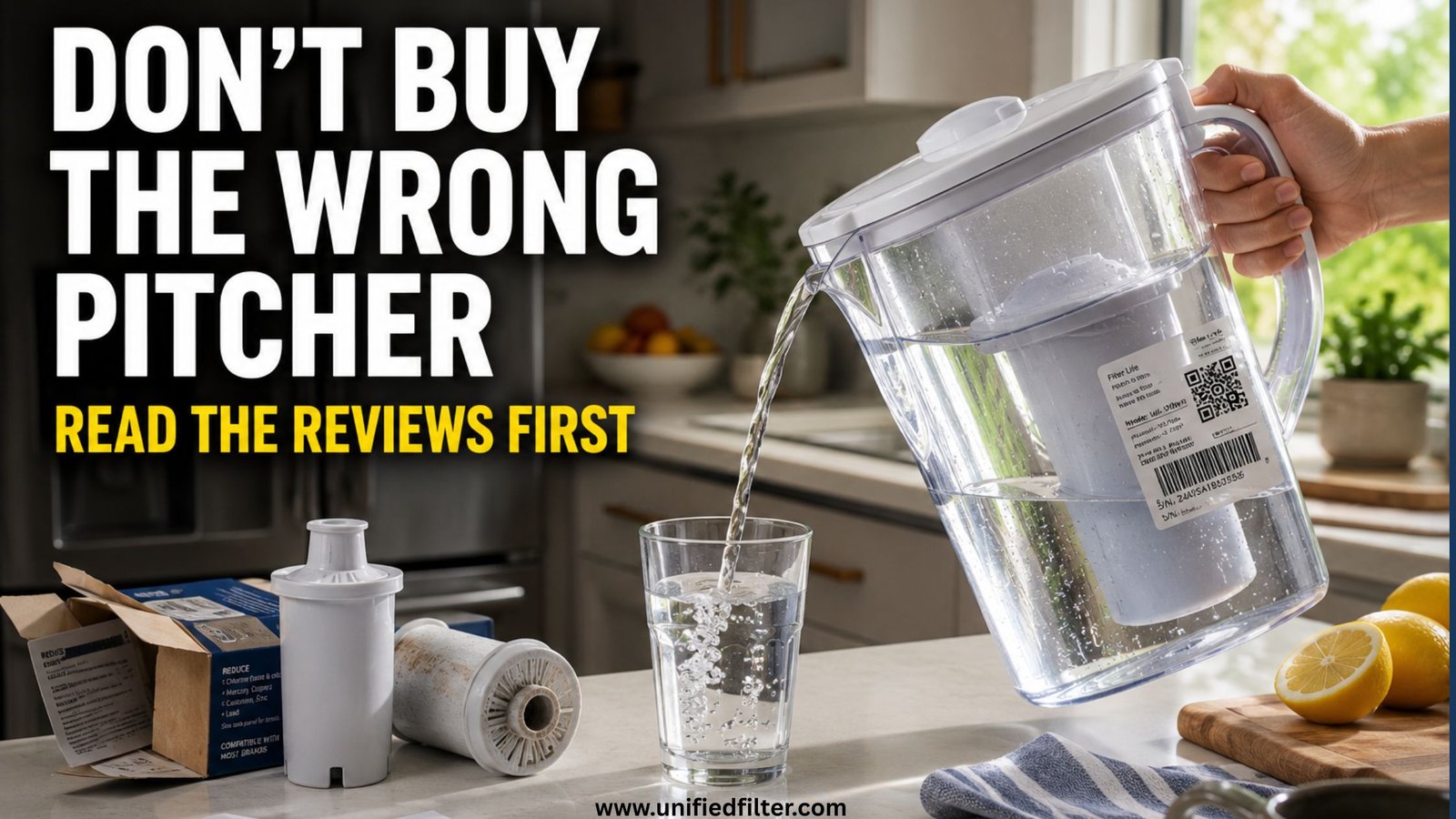
A filter pitcher is the simplest point-of-use system there is: a jug with a small carbon cartridge in the top reservoir. You fill the reservoir, gravity pulls the water slowly through the cartridge, and filtered water collects below. The carbon works by adsorption — the same method as our fridge cartridges — so its core job is the same: chlorine taste and odour reduction, the improvement you notice immediately. Beyond that, capability depends entirely on the specific model: some pitcher cartridges carry certification for additional contaminants such as lead, and some do not. That variation is the single most important fact about this category — “pitcher filter” describes a format, not a performance level. Claims live or die on the exact model’s own NSF/ANSI listing, which we return to below.
Pitcher vs Fridge Filter: The Honest Comparison
| Filter pitcher | Fridge filter (our category) | |
|---|---|---|
| Capacity | One jug at a time — commonly a few litres, refilled by hand | Continuous supply to the dispenser and ice maker, within the cartridge’s rated life |
| How it works | Gravity through a small carbon cartridge; filtration takes minutes per fill | Mains pressure through a full-size carbon block, on demand |
| Filtration scope | Taste/odour as the baseline; some models certified for lead and more — check the exact model’s listing | Certified cartridges such as genuine EveryDrop Filter 1 carry NSF/ANSI 42, 53 & 401 — chlorine, lead, pesticides, pharmaceuticals |
| Cost rhythm | Low entry cost; small cartridges replaced frequently — ongoing cost depends on the model’s interval and your usage | Genuine EveryDrop is $39.99 one-time here with free shipping, roughly twice a year |
| Ice | No — ice comes from your freezer trays, unfiltered unless you fill them from the jug | Yes — the same filter feeds the ice maker |
| Best for | Renters, no-plumbing situations, fridges with no dispenser | Households with a dispenser fridge who drink and ice a lot of water |
We have deliberately put no pitcher prices in this table. Pitcher and cartridge prices vary by model and retailer, we do not sell them, and inventing tidy numbers for products outside our store would be exactly the fake-review habit this page exists to avoid. The rhythm comparison, though, is structural and fair: pitcher cartridges are small and changed often; fridge cartridges are larger and changed about every 6 months.
The Real Limitations
Three limits define pitcher ownership, and none of them appear in most “reviews”:
They are slow. Gravity filtration takes minutes to fill the reservoir and minutes more to filter through. In a household that drinks a lot of water, the jug is perpetually half-empty or mid-filter — a small daily friction that is the top reason pitchers get abandoned in a cupboard.
Capacity is small. A jug serves glasses, not gatherings. Cooking water, kettles, guests and a family’s daily drinking stack refills up fast, and the filtered water sits at room or fridge-door temperature in limited quantity.
Cartridge life varies — a lot. Small cartridges exhaust sooner than fridge cartridges, rated life differs between models, and heavy use shortens it further. The filter you forget to change stops doing its one job while still pouring fine, so the replacement rhythm matters more here than the purchase price. Check each model’s stated interval and rated capacity before buying, and treat them as planning figures for your household’s actual usage, not guarantees.
Who a Pitcher Actually Suits
For the right household, those limits are worth it — a pitcher needs no plumbing, no dispenser and no permission:
- Renters who cannot modify plumbing and whose fridge has no filtered dispenser.
- Homes with a fridge that has no water dispenser or ice maker — the pitcher is the simplest way to get filtered drinking water in that kitchen.
- No-plumbing situations — offices, dorms, annexes and cabins where a countertop jug is the whole water system.
- Low-volume drinkers — one or two people whose daily intake a single jug genuinely covers, for whom a slow filter is no hardship.
If instead your fridge has a working dispenser, the maths usually flips: the built-in cartridge filters every glass and every ice cube on demand, which is the convenience pitchers cannot match — the comparison our cost-per-year post works through in dollars.
What to Check Before Buying Any Pitcher
Since we cannot test models for you, here is the checklist that separates a good purchase from a cupboard ornament — apply it to any pitcher, from any brand:
- NSF/ANSI listing for the exact model. Look for Standard 42 (taste, odour, chlorine) as the baseline, and Standard 53 if lead or other health contaminants are your concern. The listing must name the specific cartridge, not just the brand — marketing phrases like “reduces lead” without a standard number are not certification.
- Cartridge availability and replacement interval. Can you actually buy replacement cartridges easily, a year from now? How often does the model say to change them, and what is the rated capacity? A cheap pitcher with scarce, short-lived cartridges is the expensive option over time.
- Capacity vs household size. Match the jug’s usable volume to how much filtered water your household drinks daily — including the refill-and-wait cycle, not just the headline size.
- Where it will live. Counter or fridge shelf? Measure the space, including fridge-door clearance, before the jug arrives.
- Total cost rhythm, honestly added up. Jug price plus a year of cartridges at the stated interval — compared against the same year of the alternative you are weighing.
Frequently Asked Questions
Have you tested the pitchers in this guide? No — and the guide names no models for that reason. We do not sell pitchers and have not bench-tested any, so we publish no rankings, scores or star ratings. What we publish is how the category works and what to check before buying.
Do pitcher filters remove lead? Some models are certified to reduce lead and some are not — it is model-specific. Check the exact cartridge’s NSF/ANSI Standard 53 listing before relying on it; taste-and-odour certification (Standard 42) alone does not cover lead.
Is a pitcher cheaper than a fridge filter? The jug costs less up front; the ongoing rhythm differs. Pitcher cartridges are small and changed frequently, while a genuine EveryDrop fridge cartridge is $39.99 one-time with free US shipping here, changed roughly every 6 months. Your household’s water volume decides which rhythm wins — our cost-per-year post works the fridge side in full.
How long do pitcher cartridges last? It varies by model and by how much water you pour — significantly more than fridge cartridges do. Use the model’s stated replacement interval and rated capacity as your planning figures, and change on schedule: an exhausted cartridge pours water that is no longer being filtered as claimed.
Who should choose a pitcher over a fridge filter? Renters, anyone whose refrigerator has no dispenser, and no-plumbing setups like offices or dorms. If your fridge has a dispenser and your household drinks a lot of water, the built-in filter’s on-demand supply and ice-maker feed usually suit better.
What is the most important thing to check before buying a pitcher? The NSF/ANSI certification list for that exact model and cartridge — Standard 42 for taste and odour, Standard 53 for lead and health contaminants — followed by cartridge availability and replacement interval. Those three checks predict your experience better than any review score, including the ones we refuse to invent.