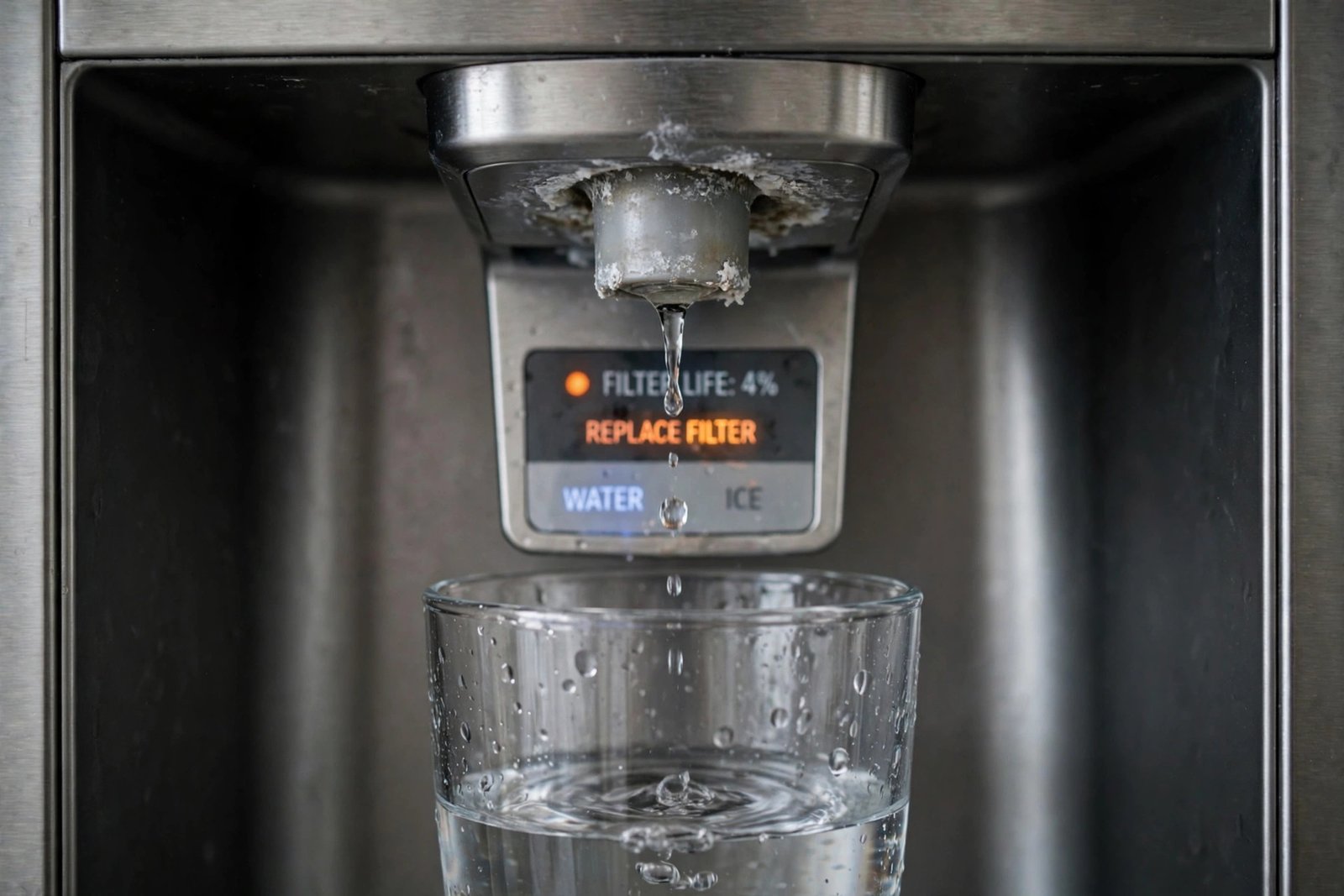

A fridge water filter does not stop working all at once — it fades. Flow slows, taste creeps back, ice gets worse, and most households put up with all of it for months before connecting the symptoms to a cartridge that costs less than a family takeaway. Here are the five signs that actually mean “change it now,” why each one happens, and what ignoring it costs you.
First, the baseline every sign is measured against: a genuine EveryDrop filter is rated for about 6 months or 200 gallons, whichever comes first. The Frigidaire PurePour PWF-1 (FPPWFU01) is rated at 125 gallons, changed every 3 to 6 months. Past those limits, the filter is not “still kind of working” — it is saturated, and saturated carbon cannot take up more of what it was filtering out.
Sign 1: The dispenser has slowed to a trickle
What you see: a glass that used to fill in seconds now takes noticeably longer; the stream looks thin or weak.
Why it happens: the cartridge has trapped months of sediment and particulates, and water now has to force its way through a clogged filter. Of all five signs, this is the one our own replacement guides name first: slow water flow is the classic overdue-filter symptom.
What it costs you: time at the dispenser every day — and a warning you should not ignore. First check the filter is fully seated (a half-seated cartridge also slows flow right after a change). If the filter is months old, though, slow flow means it is spent: replace it, do not just re-seat it.
Sign 2: Chlorine taste and odour are back
What you notice: tap-water taste and smell returning in drinking water and ice, even though the fridge “has a filter.”
Why it happens: reducing chlorine taste and odour is core carbon work (part of what NSF Standard 42 certification covers), and it is the first job a saturated filter stops doing. Taste returning is the filter telling you its carbon is full.
What it costs you: the exact benefit you paid for. Most households respond by buying bottled water instead — paying more, per gallon, than the replacement filter that would have fixed the fridge.
Sign 3: The six months (or the gallons) are simply up
What you see: nothing dramatic — just a date. The filter light may be red, or you realise the cartridge went in two seasons ago.
Why it matters: a filter can look fine and still be done. The rating is 6 months / 200 gallons for EveryDrop (3 to 6 months / 125 gallons for the PWF-1) whichever comes first — a high-use household can exhaust the gallons well before the calendar, and a low-use household still hits the time limit, because carbon sitting in water does not stay fresh indefinitely.
What it costs you: every week past the rating is a week drinking through a filter working below what it was certified to do. Write the change month on a piece of tape on the new cartridge when you install it — future-you will not have to guess.
Sign 4: Ice quality has dropped
What you see: smaller, hollow or cloudy-looking cubes, ice that tastes stale, or a maker that seems to produce less.
Why it happens: the ice maker drinks the same filtered water as the dispenser. As flow falls and filtration fades, cube quality falls with it — our Filter A guide lists dropping ice quality alongside slow flow and returning taste as a standard overdue sign.
What it costs you: drinks and entertaining quietly downgraded for months, usually blamed on the ice maker itself — a far more expensive part than the filter feeding it. Change the filter before you book a repair call.
Sign 5: Water looks cloudy or sputters — and does not clear
What you notice: cloudiness, air spurts or specks at the dispenser that keep coming back.
Why it happens — read this one carefully: a little cloudiness and sputtering in the first flush after fitting a new filter is normal trapped air, and it clears within the flush (about 1.5 gallons on a PWF-1 change). Cloudiness that appears on an old filter, or that persists long after a change and a proper flush, is different — it points to a spent or poorly seated cartridge.
What it costs you: confidence in every glass. Re-seat the cartridge until it clicks, flush again; if it persists and the filter is near its time or gallon limit, replace it.
The fix is cheaper than every symptom
A genuine replacement is $39.99 for an EveryDrop filter here, with free US shipping and no minimum — against $59.99 one-time at the official brand store. Twice a year, that is $79.98 a year for water and ice that taste the way they are supposed to. Multi-packs lower the per-filter price further and mean the next change is already in the cupboard when the signs start.
Ready to fix it? Shop the genuine EveryDrop EDR3RXD1 (Filter 3) — $39.99, free US shipping, 30-day free returns. Not sure which number your fridge takes? Read: EDR3RXD1 vs EDR4RXD1 — which EveryDrop filter does your fridge need?
Think your current filter might not even be genuine? Read next: How to spot a fake EveryDrop filter before it damages your fridge
Still not sure which filter your fridge takes? See The Complete EveryDrop Buying Guide: Filters 1, 2, 3, 4, 5 and A in One Table — find your old part number in the table and you are done in 2 minutes.
FAQ
How long does a fridge water filter actually last? About 6 months or 200 gallons for a genuine EveryDrop filter, whichever comes first. The Frigidaire FPPWFU01 (PWF-1) is rated at 125 gallons, changed every 3 to 6 months.
Can I just reset the filter light and keep using the old filter? You can reset the light on almost any fridge — but resetting the reminder does not restore the filter. The carbon stays saturated; only a new cartridge fixes flow and taste.
My flow is slow but the filter is new — is it faulty? More likely it is half-seated. Remove it, re-fit it firmly until it clicks or locks, and flush again. A half-seated filter is the most common cause of slow flow right after a change.
Is cloudy water right after a change dangerous? Brief cloudiness and sputtering after a change is trapped air leaving the line and clears as you flush. If it persists well beyond the flush, re-seat the filter and flush again.
What is the cheapest genuine way to stay ahead of these signs? Buy a multi-pack: the per-filter price drops, and having the next cartridge at home means you change it when the first sign appears instead of weeks later.