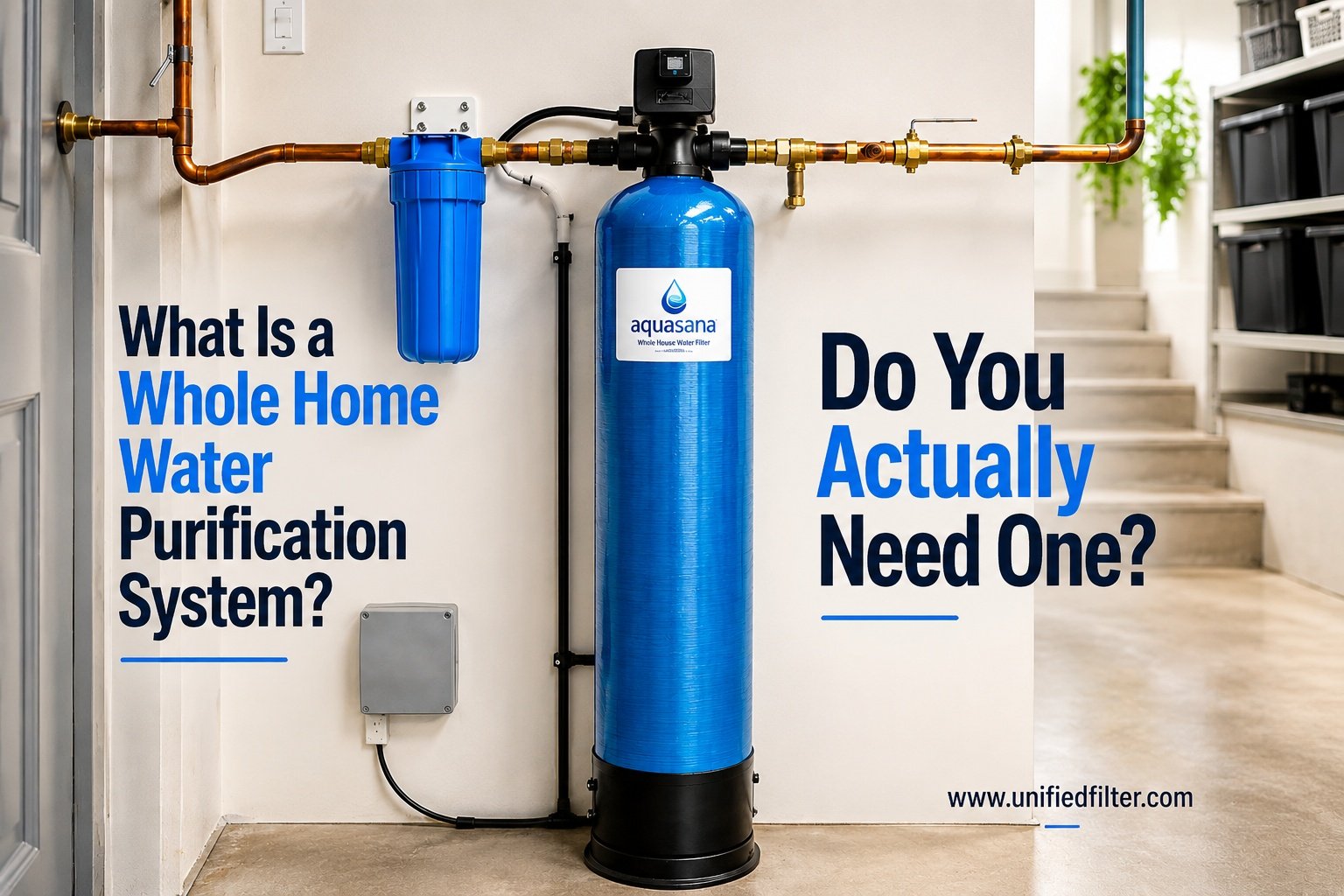

Search for a “whole-home water purification system” and you will be shown rows of tanks, bundled packages and confident promises — as if purification were simply the premium tier of filtration. It is not. The phrase on the box and the job the equipment actually does are often two different things, and the gap between them is where buyers overspend. This guide unpacks the terminology honestly: what purification properly means, what vendors are usually selling when they use the word, how packaged bundles are put together, how city-water and well-water packages differ, and the questions that separate a test-based system from a sales script. One disclosure up front: we do not sell whole-home systems of any kind — we sell refrigerator cartridges — so nothing here is priced or pitched. Where you need the engineering close-up, our companion guide to the whole-house water filter covers stages, sizing and maintenance in depth; this page is about reading the claims before you get there.
Purification Is a Standard, Not a Compliment
In careful usage, purification means more than improvement — it means making water microbiologically safe, removing or inactivating bacteria, viruses and cysts to a defined standard. That is the distinction our guide to the water purifier draws in full, and it matters here because almost nothing in a typical whole-home bundle is built or certified to that bar. Sediment cartridges strain particles. Carbon adsorbs chlorine and improves taste. A softener swaps hardness minerals. Each of those is filtration or conditioning — useful, legitimate work — but none of it is purification, and calling the row a “purification system” does not change what any stage in it can prove.
True purification at whole-house scale is rare for a simple reason: on treated municipal water it is usually unnecessary. The utility has already disinfected the supply before it reaches your street. The one stage in a whole-home row that genuinely belongs in the purification conversation is ultraviolet (UV) treatment, which inactivates microbes as water passes a UV lamp — hedged general knowledge, and relevant mainly where the supply is not disinfected upstream, which in practice means private wells. If a vendor uses the word purification, the fair question is always: which stage purifies, and to what certification?
What Vendors Usually Mean by a “System”
Strip the label away and a packaged whole-home “system” is normally a pre-assembled row of familiar stages, sold as one SKU with one installation visit. The bundle format invites vague claims, so read it as a list, not a logo.
| Bundle claim you will see | What it usually means in the row | What to check |
|---|---|---|
| “Purifies all the water in your home” | Sediment + carbon filtration at the main line | Ask which stage carries a microbiological claim — usually none does |
| “Multi-stage purification” | Several filtration stages in sequence | A stage list with a job per stage, not a stage count |
| “Chemical-free purification” | Often a softener alternative or carbon alone | What it does about hardness and chlorine, specifically |
| “Purification + softening combo” | A carbon tank paired with an ion-exchange softener | Two separate jobs — filtration and softening — priced and maintained separately |
| “Well-water purification package” | Sediment, specialty media and often a UV stage | Whether the UV stage is sized for your flow and backed by a water test |
The pattern: the word purification is doing marketing work that the stages themselves do not claim. A good vendor will happily translate their own bundle into a plain stage list. A vendor who resists that translation is telling you something.
City-Water Packages vs Well-Water Packages
The honest split in this category is not brand — it is source. City water and well water arrive with different problems, so a package that fits one is a poor template for the other.
A city-water package starts from water that is already disinfected and tested by the utility. Its real jobs are comfort and protection: sediment from mains debris, carbon for the chlorine the utility added, and softening where the supply is hard. Microbial treatment is not normally part of the picture, because the disinfection already happened upstream.
A well-water package starts from water nobody has treated. Sediment loads are often heavier, specialty problems are local and specific, and disinfection becomes a genuine question rather than a marketing one — which is why UV appears in well packages and rarely needs to in city ones. The deciding document is a proper laboratory test of your well water, repeated as your water authority advises. Any well package quoted before a test exists is a guess with plumbing attached.
Questions to Ask Any Vendor Before You Sign
You do not need to become an engineer to buy well in this category — you need these answers, in writing:
- What did my water test show, and which stage answers each finding? Every stage should trace back to a result. A stage with no finding behind it is decoration.
- What is each stage certified to, if anything? Certifications attach to specific models and specific claims — a standard number for the carbon stage’s chlorine reduction is a real answer; “certified system” with no stage named is not.
- What is the maintenance schedule, and what does each service cost? Sediment on a months-scale rhythm, carbon media on a cycle measured in years, UV lamps on their own replacement clock, softener salt as an ongoing top-up — get the whole calendar and the prices before installation, not after.
- What happens to my pressure at peak demand? The system must pass a shower, laundry and a tap together. Sizing is covered properly in our whole-house water filter deep dive — hold the vendor to it.
- What is excluded from the headline price? Installation, bypass plumbing, drain connections for backwashing designs, and first-year servicing are the usual extras.
Where the Fridge Cartridge Fits in All This
Homes with a whole-house row usually keep one more layer: the certified cartridge at the fridge dispenser, doing the targeted drinking-water job at the point of the glass. Our own part of the stack is only that last layer. The genuine EveryDrop Filter 1, the EDR1RXD1, lists certification to NSF/ANSI Standards 42, 53 and 401 plus CSA B483.1 on its product page — that is the standard of evidence to demand from any bundle stage too. Buy stages, not adjectives: the word purification adds cost, not capability, unless a UV stage and a well test are genuinely behind it.
Frequently Asked Questions
Is a whole-home purification system different from a whole-house filter? Usually not in hardware. “Purification system” is most often the marketing name for the same multi-stage filtration row — sediment, carbon, sometimes a softener. True purification means a microbiological standard, which only a stage like UV addresses, mainly on well water.
Do I need purification on city water? Generally no. Municipal water is disinfected by the utility before it reaches you, so the remaining jobs are filtration jobs — sediment, chlorine taste, hardness. Purification language on a city-water bundle is usually reassurance, not necessity.
Which stage of a whole-home system actually purifies? The UV stage, where one is fitted — it inactivates microbes as water passes the lamp. Sediment, carbon and softening stages filter or condition; they do not purify, whatever the bundle is called.
Why do well-water packages include UV more often? Because well water has not been disinfected by a utility, so microbial treatment becomes a real consideration rather than a default. A laboratory water test should decide the stage list, including whether UV belongs in it.
What should I ask a vendor before buying a packaged system? Which test result each stage answers, what each stage is certified to, the full maintenance schedule with costs in writing, the pressure behaviour at peak demand, and what the headline price excludes.
Do you sell whole-home purification systems? No — we sell refrigerator cartridges, and we say so plainly. Whole-home rows belong to specialists who can test your water and install at the main line. Our water purifier guide explains the terminology, and our part of the stack is the certified cartridge in your fridge.