
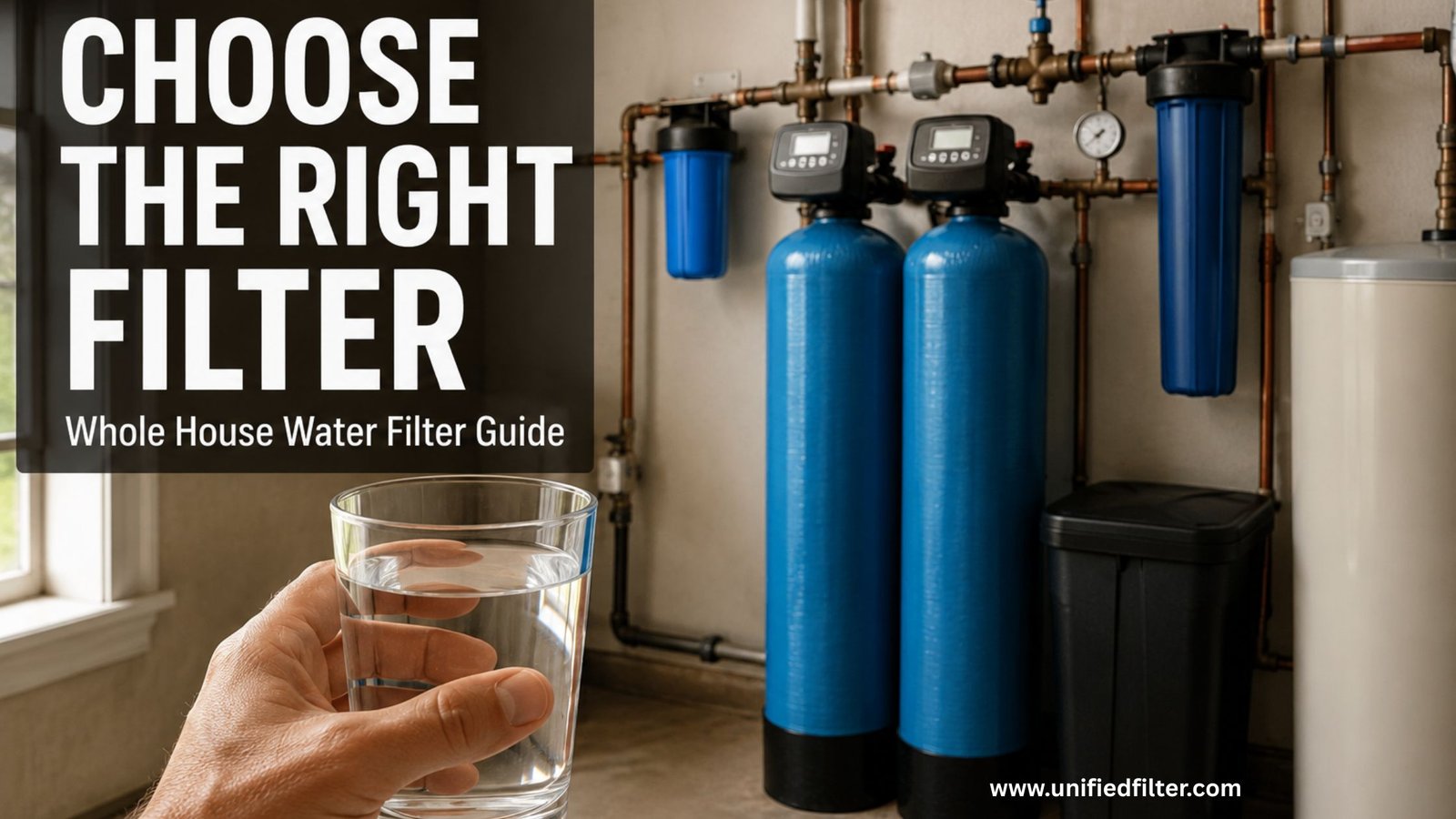

A whole-house water filter is the biggest machine in home filtration: instead of treating one glass at a time, it treats every litre the moment it enters your home — showers, laundry, baths, and the water heater all drink from it. It is also the category where one honest sentence matters most: a whole-house system is not one filter, it is a row of stages, and each stage does exactly one job. This page goes deep on that row — what each stage does and cannot do, how sizing and flow work, and why homes with a whole-house setup usually still keep a certified cartridge in the fridge. For the wider map, our companion guide to water filtration systems for homes covers the whole landscape; this page is the close-up on the point-of-entry end. And the standing disclosure: we do not sell whole-house systems — we sell refrigerator cartridges — so nothing below carries a price for equipment we do not stock.
Where a Whole-House System Sits, and What “Whole-House” Really Means
A whole-house system (plumbers call it point-of-entry) is installed on the main line, after the meter and before the plumbing branches. Every fixture downstream receives treated water; nothing upstream of it does. That placement explains both its power and its limits: it can protect pipes, heater, washing machine and showerheads from what it treats — and it treats everything, including toilet flushes and garden taps plumbed downstream, whether those uses need treating or not.
The Stages, in the Order Water Meets Them
Systems are assembled from stages matched to the water coming in, but the logic of the order is constant: coarse problems first, fine problems later, so each stage protects the next.
Stage 1 — Sediment. The bouncer. A sediment stage catches sand, grit, rust flakes and silt before they can reach anything else. On city water it guards against mains debris; on well water it often does the heaviest work in the system. It also keeps the finer, more expensive stages behind it from clogging early.
Stage 2 — Carbon. Usually a large tank of granular activated carbon, sized for the whole house’s flow. Its job is house-wide chlorine reduction: better-tasting water at every tap, kinder showers, laundry without a pool smell. Contact time is its physics — the bigger the tank relative to flow, the longer water sits with the carbon, and the better the reduction.
Stage 3 — Softening, if fitted. An ion-exchange softener is often installed alongside, but it is a different machine doing a different job: it swaps the calcium and magnesium that cause hardness for sodium or potassium, protecting heaters and pipes from scale. It does not filter anything you can taste.
Specialty stages, where the water demands them. Well water in particular may call for additional treatment aimed at specific local problems. This is the most water-report-dependent part of the row, and the stage where a proper water test — not a sales brochure — should make the decision.
| Stage | Its one job | What it does NOT do |
|---|---|---|
| Sediment filter | Catch particles — sand, grit, rust, silt | Nothing for taste, chlorine or dissolved contaminants |
| Whole-house carbon tank | Reduce chlorine and improve taste/odour at every tap | Not targeted, per-glass certified reduction of specific health contaminants the way a certified drinking-water cartridge is |
| Water softener (if fitted) | Remove hardness (calcium/magnesium) to stop scale | No filtration at all — taste, chlorine and contaminants pass through |
| Specialty stage (where fitted) | Treat one specific, tested local problem | Only ever its named target; it is not general filtration |
What Whole-House Carbon Does — and the Line It Does Not Cross
Whole-house carbon is genuinely good at its job: reducing chlorine across the entire house. That is a real quality-of-life upgrade, and it is kinder to rubber seals and some plumbing components over time, too.
But hold the line clearly: house-wide chlorine reduction is not the same thing as certified drinking-water treatment. Claims that count for health contaminants — lead is the standard example — live in certifications like NSF/ANSI Standard 53, awarded to specific cartridges tested at specific flow rates. Point-of-use cartridges are certified exactly that way: the genuine EveryDrop Filter 1 we sell is certified to CSA B483.1 and NSF/ANSI Standards 42, 53 and 401 per its product page. A big tank passing the whole house’s flow is a different engineering proposition, and any system’s actual certification list — checked model by model, never assumed from the category — is the only honest guide to what it is proven to do.
Sizing and Flow: The Part Most Buyers Skip
Two numbers decide whether a whole-house system works in practice, and neither is the price.
Flow capacity. The system must pass your home’s peak demand — a shower, the washing machine and a tap running at once — without strangling pressure. An undersized system announces itself as sad showers whenever a second fixture opens. Sizing follows the home: bathrooms, occupants and habits set the peak.
Pressure drop. All filtration costs some pressure, and a healthy system keeps that cost small. A rising pressure drop over time is information: it usually means the sediment stage is loading up, doing its job, and due for its change.
Installation needs space at the main line, a bypass so the house can run untreated during servicing, and — for self-cleaning tank designs — a drain connection for the backwash cycle. Budget for a proper install, and let the installer and your water test shape the final stage list.
Maintenance Rhythms, in General Terms
Whole-house maintenance runs on three clocks. The sediment stage is serviced most often — on a months-scale rhythm, sooner on dirty well water. Carbon tank media is the long clock: a large bed of carbon serving the whole house is replaced on a cycle measured in years, which is precisely why these tanks are big. Softener salt, where fitted, is a regular top-up. Whole-house systems trade the fridge cartridge’s six-month simplicity for a row of schedules — put the dates in a calendar when the system goes in.
Why the Fridge Cartridge Usually Stays
If the whole house is filtered, why keep changing the little cartridge in the fridge? Because the two do different jobs, and the last metre matters. The whole-house row protects the house broadly — sediment out, chlorine down, scale prevented. The cartridge at the dispenser is the certified specialist at the exact point you drink: tested, per its certification list, for the specific health contaminants its standards name. It is also the final barrier before your glass.
Manufacturers acknowledge the arrangement can run the other way, too: the EDR1RXD1 product page notes a bypass plug can be used with a whole-house system if you prefer the fridge to run unfiltered. That is a legitimate choice — just make it knowingly, understanding which layer you are switching off. Most households keep both layers: coarse defence at the door, certified precision at the glass.
What We Sell, Honestly
We sell the last layer only: refrigerator cartridges, including genuine EveryDrop at $39.99 one-time with free US shipping on any order amount, processed within 1–2 business days, delivered in 3–5 business days via USPS, with free 30-day returns on a prepaid label. Whole-house systems belong to the specialists who test, size and install them — buy that row from them, with a water test in hand. And if you are planning the full stack, start from the map in our water filtration systems for homes guide, then bring the drinking-water end to us.
Frequently Asked Questions
Does a whole-house filter mean I can stop changing my fridge filter? Not automatically. The whole-house row does broad jobs — sediment, chlorine, hardness — while the fridge cartridge is the certified drinking-water specialist at the tap. A bypass plug exists, as the Filter 1 page notes, but using it switches off the certified layer at your glass.
What does whole-house carbon actually remove? Primarily chlorine, with the taste and odour improvement that follows, at every tap in the house. It is not, by category, certified targeted reduction of health contaminants like lead — check the specific system’s own certification list for anything beyond taste and odour.
How do I know what stages my home needs? Test the water. Sediment and chlorine are near-universal; hardness and specialty stages should be answers to things a test actually found. Stage lists sold without a water test are guesses with plumbing attached.
Will a whole-house system drop my water pressure? Some pressure drop is inherent to pushing water through media, and a correctly sized system keeps it barely noticeable at peak demand. Noticeable, worsening drop usually signals a loaded sediment stage due for service — or a system undersized for the house.
How often does a whole-house system need maintenance? On several clocks at once: the sediment stage on a months-scale rhythm, carbon tank media on a cycle measured in years, and softener salt topped up regularly if one is fitted. The manufacturer’s schedule for your model is the authority.
Do you sell whole-house water filters? No — we sell refrigerator cartridges, and we say so plainly. Whole-house systems should come from a specialist who can test your water, size the flow and install at the main line. Our part of the stack is the certified cartridge in your fridge.