
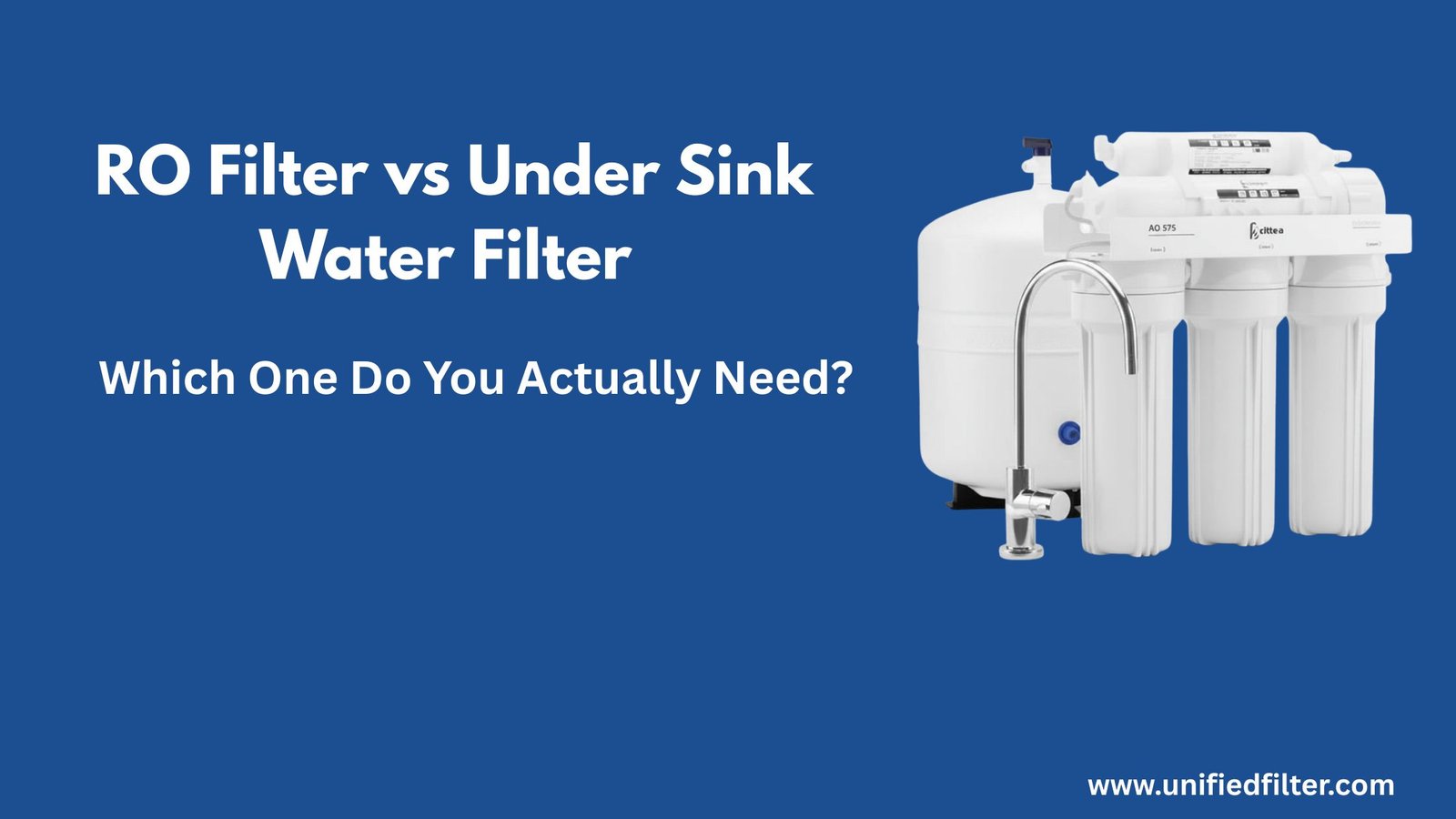

Reverse osmosis is the heavyweight of home water filtration — the one technology that handles the job carbon cannot: dissolved solids. If you have read our map of water filtration systems for homes, you know RO sits at the deep-treatment end of the scale. This page is the close-up: what actually happens inside an under-sink RO unit, stage by stage; what the membrane does that no carbon cartridge can; the trade-offs that brochures underplay — wastewater, slow production, stripped minerals; and the maintenance rhythm that keeps one honest. The disclosure first, as everywhere on this site: we do not sell RO systems. We sell refrigerator filter cartridges. This is an explainer for households weighing the technology, written by people who sell a different, smaller tool and have no stake in talking you into this one.
Osmosis, Reversed
Start with the name. Osmosis is water’s natural tendency to move across a semi-permeable membrane toward the side with more dissolved material, balancing concentrations. Reverse osmosis applies household water pressure to push water the other way — from the dissolved-solids side through the membrane to the clean side. The membrane’s pores are fine enough that water molecules pass while the large majority of dissolved solids — salts, minerals, dissolved metals — cannot. What emerges on the clean side is water with most of its dissolved content stripped out. That single capability is the whole reason RO exists: every other common home filter works on particles and surface chemistry, and dissolved solids sail through all of them.
Stage by Stage: What Happens Inside the Box
An under-sink RO unit is not one filter; it is a row of them, and the membrane is only the centrepiece:
Stage 1 — the sediment pre-filter. A simple straining cartridge catches sand, rust and grit. Its job is protection: debris that reaches the membrane damages it.
Stage 2 — the carbon pre-filter. Carbon removes chlorine before the water reaches the membrane, because standard RO membranes are degraded by chlorine. This is the quiet irony of RO shopping: the famous membrane still needs an ordinary carbon filter standing guard in front of it.
Stage 3 — the membrane. Pressurised water meets the semi-permeable membrane. The large majority of dissolved solids are rejected and carried away in a stream of reject water that goes to the drain. The cleaned water — permeate, in the jargon — passes through at a trickle.
Stage 4 — the storage tank. Because the membrane works slowly, RO water is made in advance and held in a small pressurised tank under the sink, so a glass fills at normal speed from storage rather than at membrane pace.
Stage 5 — the post-filter. Before the dedicated RO faucet, the stored water usually passes a final carbon polishing filter that freshens taste after its time in the tank.
Everything except Stage 3 is ordinary filtration doing ordinary jobs. The membrane is the only stage that changes the water’s dissolved content — which is why “it has five stages” is a weak selling point and “it is a well-maintained membrane, fed by fresh pre-filters” is the real specification.
What the Membrane Does That Carbon Cannot
Carbon works by adsorption — compounds sticking to a vast internal surface, as our water purifier guide’s companion pieces explain — and it is excellent at chlorine, taste and odour, and certified reductions of named contaminants. But dissolved solids are not held by that surface. Sodium, calcium, dissolved minerals — collectively measured as TDS — pass through carbon essentially unchanged, which is why a TDS meter reads almost the same after a carbon filter. The membrane is a physical barrier at a scale fine enough to reject dissolved material itself. If your problem is TDS — brackish well water, very hard-to-taste municipal supplies, a specific dissolved contaminant the membrane is certified for — carbon was never the tool. If your problem is chlorine taste at the fridge dispenser, the membrane is unnecessary machinery. Matching tool to problem is the whole game, here as everywhere.
The Trade-Offs, Stated Plainly
RO’s brochures lead with purity. These are the costs that come with it:
Wastewater. The membrane separates water into a clean stream and a reject stream, and the reject stream goes down the drain. On many home systems, several litres are sent to drain for every litre of RO water produced. Newer designs improve the ratio; none abolish it. Households on metered water or septic systems should count this honestly.
Slow production. The membrane’s trickle is why the tank exists. A healthy system keeps up with a household’s drinking and cooking; a tired membrane or cold feed water slows it further, and the first symptom is a tank that runs empty by evening.
Minerals go too. The membrane does not distinguish contaminants from calcium and magnesium. RO water is low-mineral water — flat-tasting to some palates, and the reason remineralising post-filters exist as an option. Whether that matters to you is a preference question, not a safety one, on ordinary supplies.
Space and plumbing. Tank, filter row and a drain connection live under the sink, and most systems feed a dedicated faucet. This is an installation, not an accessory.
Under-Sink RO vs Whole-House RO
Nearly all home RO is point-of-use: one sink, drinking and cooking water only. That is not a limitation of ambition — it is arithmetic. A membrane that produces drinking water at a trickle, sending several litres to drain per litre made, cannot supply showers, laundry and toilets without industrial-scale membranes, storage and water bills. Whole-house RO exists in unusual situations, but for ordinary homes it is rare and impractical; whole-house treatment is normally the job of sediment, carbon and softening stages at the main line, with RO added at the one tap where dissolved solids matter. Any vendor proposing whole-house RO for a standard home on municipal water deserves hard questions.
The Maintenance Rhythm
An RO system is a small ecosystem, and each part ages on its own clock — follow the manufacturer’s schedule for your unit, because these are general patterns, not your manual. The pre-filters (sediment and carbon) work on the shorter cycle: they are consumables doing heavy protective work, and letting the carbon pre-filter expire exposes the membrane to the chlorine it was guarding against. The post-filter follows a similar shorter rhythm. The membrane itself is the long-life component, typically lasting years rather than months when its pre-filters are maintained — and failing early, expensively, when they are not. The pattern to remember: in an RO system, the cheap filters protect the expensive one, so the maintenance schedule is really a membrane-protection schedule.
Frequently Asked Questions
Do you sell RO filters or RO systems? No. We sell genuine refrigerator water filter cartridges. RO systems are sold and installed by water-treatment specialists — this page exists so you can judge the technology honestly before talking to one.
What does reverse osmosis remove that carbon cannot? Dissolved solids — the salts and minerals measured as TDS. Carbon adsorbs chlorine and chemicals onto its surface but lets dissolved material pass; the RO membrane physically rejects the large majority of dissolved solids.
How much water does an RO system waste? It varies by design, but on many home systems several litres go to drain for every litre of RO water produced. That reject stream is how the membrane disposes of what it rejects. Check the specific system’s stated ratio before buying.
Does RO remove minerals as well as contaminants? Yes. The membrane rejects dissolved material broadly, including the calcium and magnesium that give water its mineral character. Some systems add a remineralising stage for taste; it is a preference option, not a safety requirement on ordinary supplies.
Can RO treat the whole house? Technically in rare setups, practically no for ordinary homes. Membrane production is slow and the reject water volume is large, so whole-house needs are met with sediment, carbon and softener stages instead, reserving RO for the drinking tap.
How often do RO filters need changing? On the manufacturer’s schedule for your unit. The pattern: sediment and carbon pre-filters and the post-filter run on a shorter cycle, the membrane on a much longer one measured in years — and membrane life depends on the pre-filters being changed on time.