
If you are shopping for a water filter for lead, you are shopping for one specific thing — whether the listings tell you so or not: a cartridge that is certified to reduce lead. Not “carbon”, not “5-stage”, not “purifier-grade”. Lead is invisible, tasteless, and a genuine health hazard, and the only honest way to buy protection against it is to check for the certification that names it. This guide explains where lead in tap water actually comes from, which standard covers it, the interim steps that help while you sort a filter out, and the certified cartridges we sell — with their certification wording taken from their own product pages.
Why Lead Deserves the Serious Treatment
US public-health authorities are unusually blunt about lead: there is no safe level of lead exposure, particularly for children, whose developing bodies absorb it more readily. Lead is a neurotoxin, and the harm it does is cumulative and largely irreversible — which is why the guidance around drinking water treats any reduction as worthwhile and any exposure as worth taking seriously. That bluntness is also why this page refuses to be casual: with lead, the difference between a certified cartridge and an uncertified one is not marketing polish, it is the entire point.
Where the Lead Actually Comes From
Here is the part most people get wrong: the water usually leaves the treatment plant with little or no lead in it. Lead typically enters on the last stretch — from a lead service line connecting older homes to the main, from lead solder in household plumbing (common in homes built before the late 1980s, as commonly documented), and from brass fixtures and fittings that leach small amounts as water sits in them. Two practical consequences follow. First, your neighbour’s water test tells you nothing certain about yours — the plumbing is the variable. Second, the point where you can do something about it is inside your home, at the tap or the fridge dispenser, which is precisely where a certified filter sits.
Water Filters That Remove Lead: What to Look For
If you searched for water filters that remove lead, the short answer is: look for a cartridge certified to NSF/ANSI 53 for lead reduction — that certification, not the marketing, is what proves the filter actually removes lead.
The Standard That Counts: NSF/ANSI 53
Filtration certifications are organised by standard, and they are not interchangeable:
- NSF/ANSI Standard 42 covers aesthetic effects — chlorine taste and odour. A filter certified only to Standard 42 has made no certified lead claim at all, whatever its box art suggests.
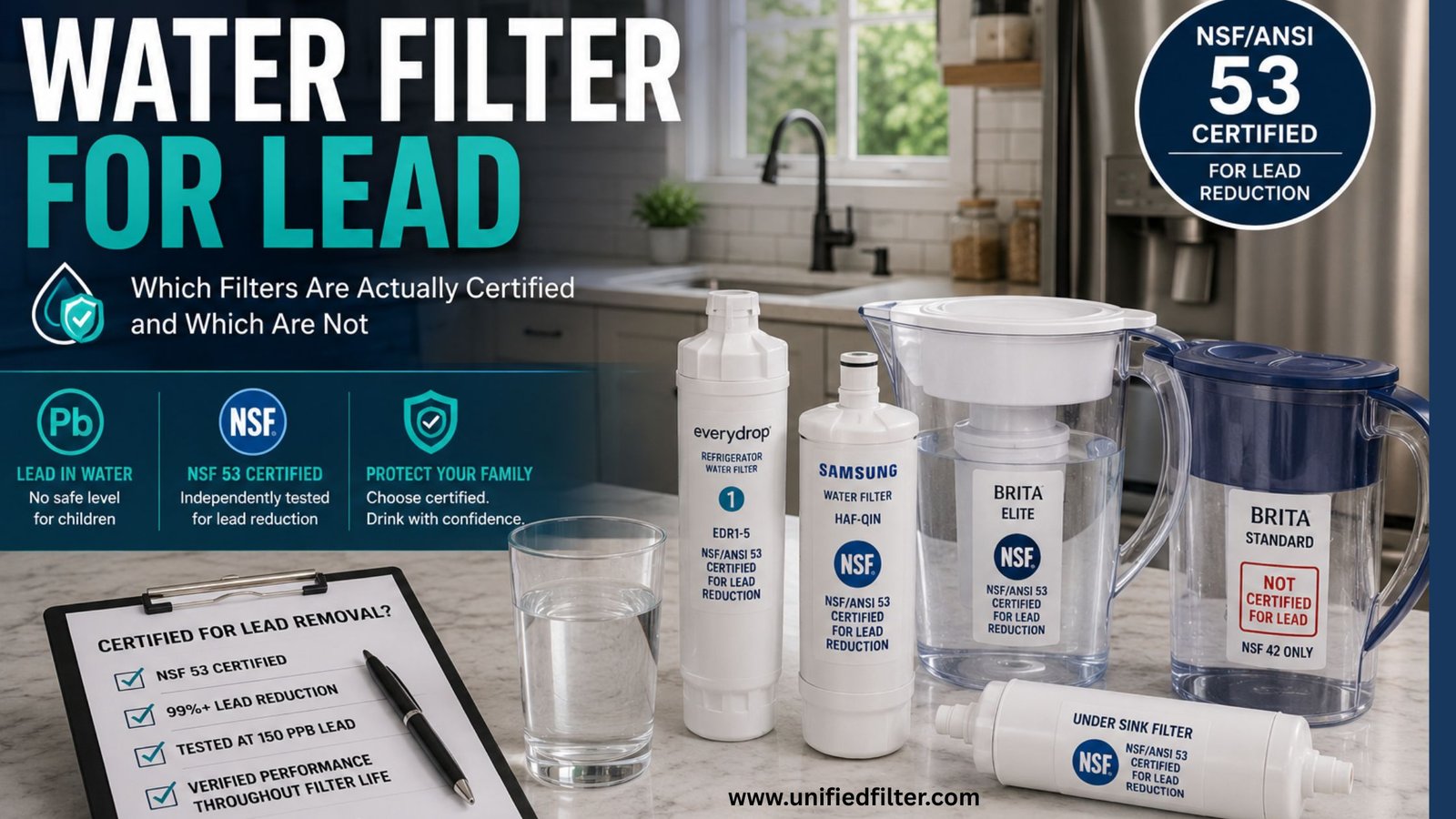
- NSF/ANSI Standard 53 covers health contaminants, and lead reduction is one of its named claims. A cartridge certified to Standard 53 for lead has been independently tested reducing lead to the standard’s limit.
- NSF/ANSI Standard 401 covers emerging compounds such as pharmaceuticals — valuable, but a different list from lead.
So the buying rule is short: for lead, look for Standard 53, and confirm lead appears in that cartridge’s own reduction list. Our explainer on NSF certified water filters walks through how to read a certification list properly — it is a two-minute skill that protects every filter purchase you ever make.
The Certified Cartridges We Sell
Both cartridges below are genuine OEM parts whose product pages on this site state their certifications and name lead in their reduction lists:
| Cartridge | Fits | Certifications (as stated on its product page) | Lead named? | Rated life |
|---|---|---|---|---|
| EveryDrop Filter 1 — EDR1RXD1 | Whirlpool, Maytag, KitchenAid, Amana, JennAir | CSA B483.1; NSF/ANSI Standards 42, 53 and 401; certified to reduce up to 70 contaminants including lead, pesticides and pharmaceuticals | Yes — including lead | 6 months / 200 gallons |
| Samsung DA29-00020B (HAF-CIN) | Samsung French-door and side-by-side | Tested and approved by NSF International against NSF/ANSI Standards 42, 53 and 401; removes 40+ contaminants including chlorine, lead, mercury, cysts and asbestos | Yes — listed among its removals | 6 months / 300 gallons |
The Filter 1 is $39.99 one-time here — against $59.99 one-time at the official EveryDrop store, or $48 only with a subscription — and the genuine Samsung cartridge is sold here from $36.97 by pack size, per its product page. Both ship free within the US on any order amount; Filters Fast, by comparison, ships free only at $99+ and Discount Filter at $70+.
Interim Steps That Genuinely Help
While a certified cartridge is on its way (ours are processed within 1–2 business days and delivered in 3–5 business days via USPS), standard public-health guidance offers partial measures — partial being the operative word:
- Flush after standing. If water has sat in the pipes for hours — first thing in the morning, after a holiday — run the cold tap for a short while before drawing drinking water. Water that has sat in contact with solder and fixtures carries the most lead; flushing replaces it with fresher water from further back in the system.
- Use cold water for drinking and cooking. Hot water dissolves lead from plumbing more readily; draw cold and heat it on the stove.
- Do not treat these as a solution. Flushing reduces exposure; it does not certify anything, and it depends on you remembering every time. The filter is the fix; the habits are the bridge.
The Pitcher Caveat
A filter pitcher can be part of a lead strategy — but only the specific models whose own certification list names lead under Standard 53. Pitcher capability varies enormously by model, and a pitcher certified only for taste and odour does nothing certified for lead at all. Our honest pitcher buying guide explains how to check any model before buying. The same rule applies everywhere, incidentally: check the exact cartridge, not the brand’s general reputation.
The Maintenance Half of the Promise
A lead certification describes a cartridge within its rated life — not the same cartridge a year past it. As carbon exhausts, the reductions it was certified for fall away, quietly, while the water still looks and tastes fine. Both cartridges above are rated at 6 months (200 gallons for the Filter 1; 300 gallons for the Samsung), and that rating is part of the protection you bought. Change on schedule; if you want the wider picture of how fridge filtration fits alongside whole-house options, our map of water filtration systems for homes covers the combinations. Orders here carry free 30-day returns with a prepaid label if you order the wrong cartridge — and if in doubt, send us the number on the cartridge you removed before ordering, and we will confirm the right one.
Frequently Asked Questions
What certification should a water filter for lead have? NSF/ANSI Standard 53, with lead named in that specific cartridge’s reduction list. Standard 42 alone covers only taste and odour and certifies nothing about lead.
Where does the lead in my tap water come from? Usually your own plumbing’s last stretch: a lead service line on an older home, lead solder in household pipes, or brass fixtures. The treated water generally leaves the plant with little or no lead — which is why point-of-use filtration is the practical answer.
Is the EveryDrop Filter 1 certified for lead? Yes. Its product page lists certification to NSF/ANSI Standards 42, 53 and 401 plus CSA B483.1, and describes it as certified to reduce up to 70 contaminants including lead, pesticides and pharmaceuticals.
Does flushing the tap remove the need for a filter? No. Flushing after water has stood, and using cold water for drinking, are worthwhile interim habits that reduce exposure — but they are not certified reduction, and they rely on perfect consistency. A certified cartridge works on every glass, including the ones you forget to flush for.
Will any carbon filter reduce lead? Carbon is the medium, certification is the proof. Some carbon cartridges are certified for lead and some are not; without a Standard 53 lead claim for that exact cartridge, you are relying on hope. Check the list.
How often must I change the filter for the lead protection to hold? On its rated schedule: 6 months or 200 gallons for the EDR1RXD1, 6 months or 300 gallons for the Samsung DA29-00020B. Past its rated life, a cartridge’s certified reductions can no longer be assumed.