
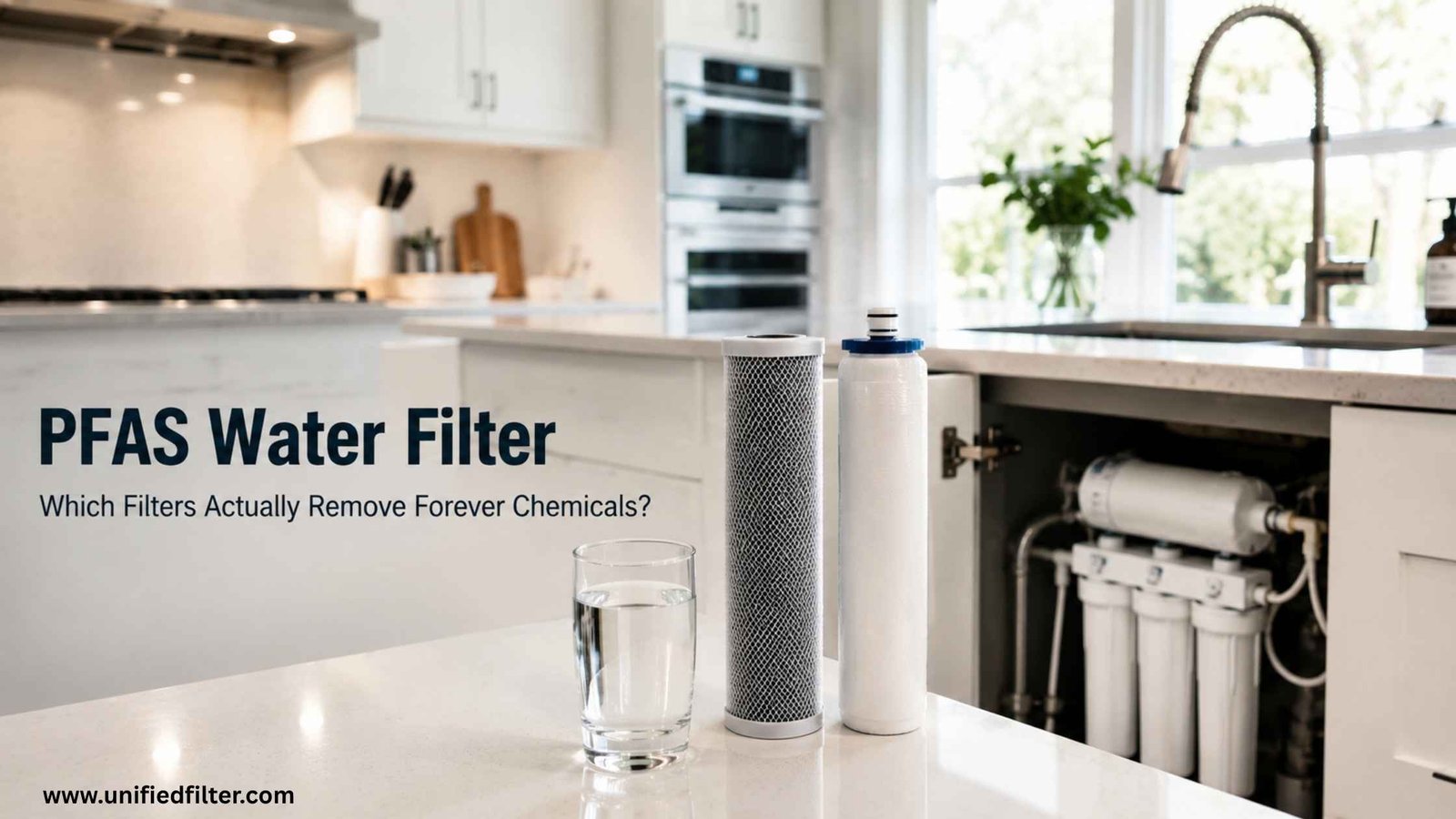

PFAS have moved from chemistry journals to kitchen-table worries in a few short years, and the filter market has responded the way it always does: quickly, loudly, and with claims that outrun the certifications behind them. This guide takes the slower route. It explains what PFAS actually are, why regulators have moved on them, which filtration methods are commonly used against them, and — most importantly — how to verify any cartridge’s PFAS claim before you spend a dollar, including ours. That verification habit matters more than any single product recommendation, because with PFAS the gap between “carbon filter” and “certified for PFOA/PFOS reduction” is exactly where shoppers get misled.
What PFAS Are, in Plain Terms
PFAS — per- and polyfluoroalkyl substances — are a large family of synthetic chemicals used for decades in products valued for resisting water, grease and stains: nonstick coatings, food packaging, waterproof fabrics, firefighting foams and more. They earned the nickname “forever chemicals” because the bonds that make them useful also make them break down extremely slowly in the environment and in the body. Two members of the family, PFOA and PFOS, are the most studied and the most widely discussed; when people say “PFAS in water”, those two are usually at the centre of it. Because the family numbers in the thousands, no single test or filter claim covers “PFAS” as a whole — a point that matters when we get to certifications.
Why They Are in the News
Regulators have been tightening their position on PFOA and PFOS for years, and the US Environmental Protection Agency has moved to regulate these two compounds in public drinking water — setting enforceable limits for water utilities rather than leaving them as unregulated contaminants. That regulatory step is the main reason PFAS filtration has gone mainstream: once a contaminant has a legal limit in tap water, households reasonably ask what their own tap delivers and what a filter can do about it. Public water systems are being required to monitor and comply, so your local water quality report is a real source of information, not a formality.
How Filtration Addresses PFAS
The methods commonly cited for PFAS reduction are these — stated generally, because performance always comes down to the specific product, its condition and the water it is treating:
| Method | How it addresses PFAS | The honest caveat |
|---|---|---|
| Activated carbon (granular or carbon block) | PFAS adsorb onto the carbon’s surface as water passes; commonly cited as effective for longer-chain PFAS such as PFOA and PFOS | Capacity is finite and breakthrough happens as the carbon exhausts — an overdue cartridge is a shrinking defence. Short-chain PFAS are harder for carbon to hold |
| Reverse osmosis | A membrane fine enough to reject dissolved substances broadly, including PFAS compounds | Rejects a portion of water as waste, strips minerals, and needs its prefilters maintained to protect the membrane |
| Ion exchange (specific resins) | Charged resin beads capture PFAS ions; used in some point-of-use and whole-house systems | Resin selection and exhaustion decide everything; a general softener is not a PFAS resin |
Notice the pattern: every method works until it doesn’t — until carbon exhausts, resin fills, or maintenance lapses. PFAS filtration is a maintenance discipline as much as a purchase. Our broader map of water filtration systems for homes shows where each method sits in a household setup.
The Certification Reality: Check the Cartridge’s Own List
Here is the section the whole page exists for. Filtration certifications are granted per product, per claim. NSF/ANSI Standard 401 covers “emerging contaminants” and Standard 53 covers health contaminants — and specific cartridges have been certified under these standards for PFOA/PFOS reduction. But a cartridge carrying Standard 401 certification for pharmaceuticals has not thereby been certified for PFAS. The letters are the same; the claim list is different. The only reliable check is that cartridge’s own certified reduction list — in the manufacturer’s certification documents or the certifier’s listing — naming PFOA and/or PFOS explicitly.
That rule applies to our shelves exactly as it applies to everyone else’s, so here is our own example stated plainly. The genuine EveryDrop Filter 1, the EDR1RXD1, has a product page listing certification to NSF/ANSI Standards 42, 53 and 401 plus CSA B483.1, and describes certified reduction of up to 70 contaminants including lead, pesticides and pharmaceuticals. Its product page does not specifically list PFAS, PFOA or PFOS — so we do not claim PFAS certification for it, and this page will not pretend otherwise. It remains a thoroughly certified fridge cartridge for the contaminants it does list, explained in our water filter for fridge guide. If PFAS reduction is your specific target, use the check above on any cartridge you consider — ours included — and buy the one whose own list names PFOA/PFOS.
A Sensible Plan If PFAS Is Your Concern
- Read your water quality report. Utilities publish annual consumer confidence reports, and systems are now monitoring for PFOA and PFOS under the EPA’s rules. Know what your supply actually shows before shopping.
- Consider a home water test if your supply is a private well or your report leaves you unsure — a result turns anxiety into a specification.
- Choose by the claim list, not the category. “Carbon filter” is a method, not a PFAS promise. Look for PFOA/PFOS named in the specific cartridge’s certification.
- Respect the change interval. Whatever you buy, its PFAS performance is at its certified level only within its rated life. Change on schedule — for fridge cartridges like the ones we sell, that is roughly every 6 months.
What We Sell, Stated Straight
Discounted Filter Store sells genuine refrigerator cartridges — EveryDrop, Samsung and Frigidaire — certified for the contaminant lists on their own product pages, priced honestly: every genuine EveryDrop cartridge is $39.99 one-time with free US shipping on any order amount, against the official store’s $59.99 one-time or $48 by subscription, with Filters Fast shipping free only at $99+ and Discount Filter at $70+. Orders process within 1–2 business days, arrive in 3–5 business days via USPS, and return free within 30 days on a prepaid label. For broad filtration those cartridges are the real thing. For PFAS specifically, we have told you how to check — and we would rather lose a sale to that honesty than win one with a claim our own product page doesn’t make.
Frequently Asked Questions
What are PFAS, PFOA and PFOS? PFAS are a large family of synthetic chemicals that break down very slowly — hence “forever chemicals”. PFOA and PFOS are the family’s two best-known and most regulated members, and the ones drinking-water rules and filter claims usually refer to.
Has the EPA regulated PFAS in drinking water? The EPA has moved to regulate PFOA and PFOS in public drinking water, setting enforceable limits that utilities must monitor and meet. Your water quality report is the place to see your own supply’s position.
Does a carbon filter remove PFAS? Activated carbon is commonly cited as able to reduce longer-chain PFAS like PFOA and PFOS — but “carbon” alone is not a guarantee. Only a specific cartridge certified for PFOA/PFOS reduction, and changed on schedule, carries the tested claim. Check the individual product’s reduction list.
Is the EveryDrop Filter 1 certified for PFAS? Its product page lists NSF/ANSI 42, 53 and 401 plus CSA B483.1 certification and names lead, pesticides and pharmaceuticals among its reductions — it does not specifically list PFAS, PFOA or PFOS, so we make no PFAS claim for it. Buy for PFAS only where the claim is named.
Does reverse osmosis remove PFAS? RO membranes are commonly cited as effective against PFAS, as part of their broad rejection of dissolved substances. The trade-offs are wastewater, stripped minerals and maintenance — and again, the specific system’s own certification is the proof that counts.
How often must a filter be changed to keep PFAS reduction? Within its rated life — the certification describes a maintained cartridge, not an exhausted one. Carbon that has adsorbed to capacity can let contaminants through, so the manufacturer’s interval (about 6 months for fridge cartridges) is part of the protection.