
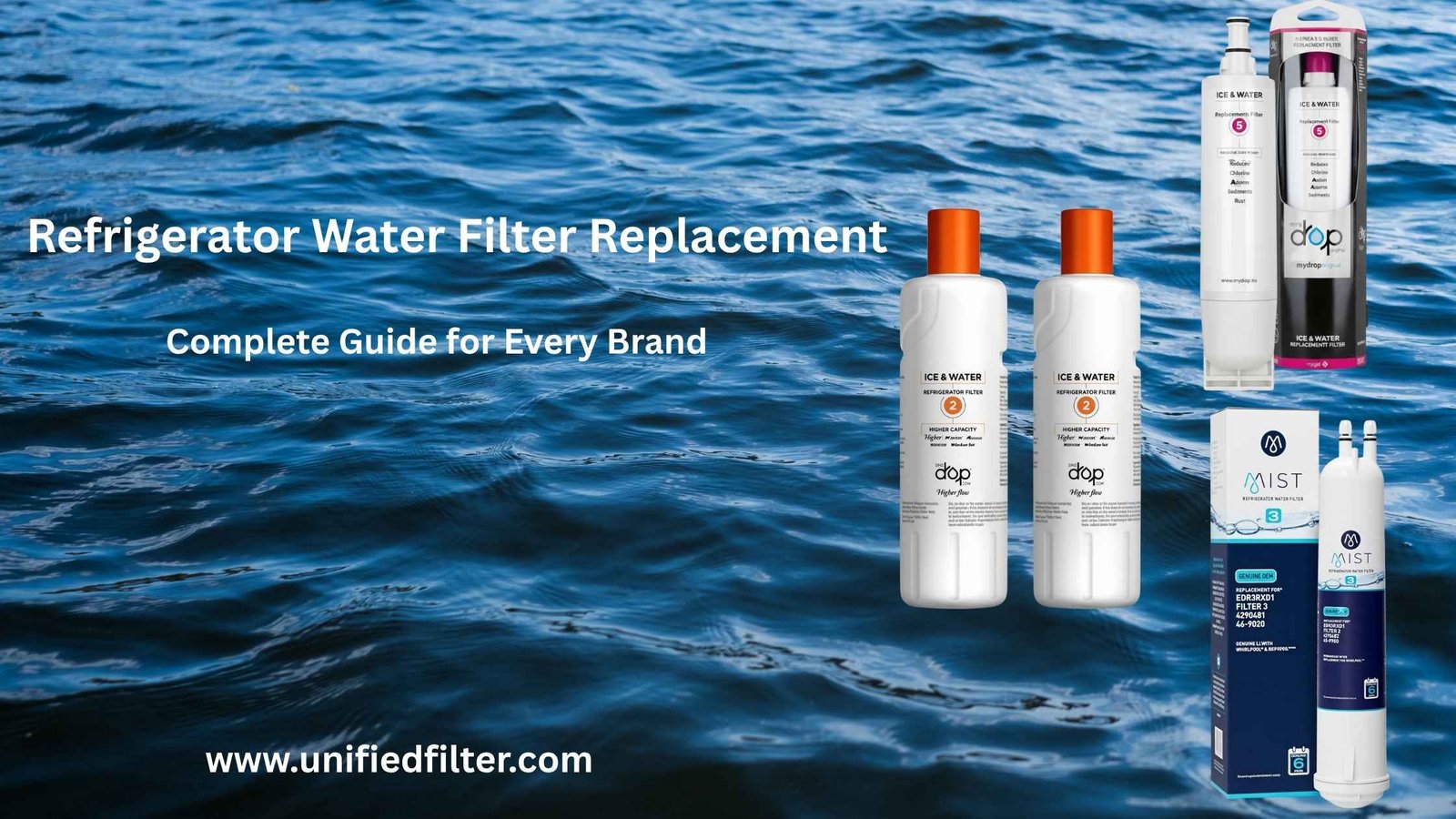

Replacing a refrigerator water filter is one of the easiest jobs in the kitchen — no tools, no plumber, about five minutes start to finish. Yet owners put it off for months, usually because the housing is unfamiliar or a past attempt sputtered, dripped or left the warning light glowing red.
This walkthrough removes the mystery. Every cartridge in the fridge — EveryDrop, Samsung, Frigidaire — changes by the same four universal steps; only the release motion varies by housing. Learn the universal method once, check the variation for your housing type, and the job is yours for life.
Before You Start: The Two-Minute Checklist
- Confirm the new cartridge matches the old one’s number. The label on the filter coming out is the final authority — EDR1RXD1 out means EDR1RXD1 in. Numbers are different shapes and do not interchange.
- Put a small towel under the housing. A few tablespoons of water escape when the old cartridge releases. Normal, expected, and the only mess this job makes.
- Note the date. Write today’s date on the new cartridge’s label with a marker before it goes in. Six months from now, that date is your reminder system.
- Know whether your model wants the water off. Most interior housings self-seal when the cartridge is removed — Frigidaire’s PWF-1 page states plainly that turning the supply off is not necessary — while Samsung’s DA29-00020B page includes turning the line off in its steps. Follow your cartridge’s own page or manual.
The Four Universal Steps
Step 1 — Remove the old cartridge. However your housing releases it (see the variations below), the old filter comes out with a twist, a push or a quarter-turn. Pull it straight out once released; tilting a full cartridge spills its contents.
Step 2 — Seat the new cartridge. Remove the protective cap, align the cartridge with the housing (many have an alignment guide or a keyed shape that only fits one way), and push or twist until it locks. You are listening for a click or feeling a firm stop. A cartridge that is almost seated is the number-one cause of slow flow and drips — push until it is home.
Step 3 — Flush. Run the dispenser and discard the water: 2–3 gallons on most models (the EDR1RXD1 page specifies about 4 gallons; Frigidaire’s PWF-1 page says roughly 1.5 gallons over 3–4 minutes). Sputtering and spurts of air are completely normal at first — that is trapped air and loose carbon leaving the new media. Then discard the first batch of ice, which catches anything the flush missed.
Step 4 — Reset the indicator light manually. A new cartridge never resets the light by itself. On most models you press and hold the filter/water-filter button on the control panel for about 3 seconds until the indicator changes (Frigidaire’s page describes its display changing from red to green). Check your manual for your model’s exact button if the light does not respond.
Per-Housing Variations
The four steps are universal; the release in Step 1 and the lock in Step 2 wear four different costumes:
- Base-grille quarter-turn (Filter 3 and grille-style Filter 4 housings). The housing is behind the grille at the bottom front of the fridge. Twist the cap or cartridge a quarter-turn counterclockwise, pull it out, transfer the reusable cap to the new cartridge if your model uses one, slide the new filter in and turn it back until it locks. Our EDR4RXD1 / UKF8001 replacement guide walks this housing through in detail.
- Upper-right push-button (Filter 2). Inside the fresh-food compartment, top right. Press the eject button or lift the cover; the cartridge pops partway out. Pull it free, align the new EDR2RXD1, and push with a slight clockwise turn until it clicks.
- Interior twist-in (Filters 1 and 5). Open the housing cover (top-right or lower interior, by model), twist the old cartridge counterclockwise and pull, then push the new one in and twist until it clicks. The step-by-step Filter 1 walkthrough covers this housing with its reset sequence.
- Twist-and-lock (Filter A and the Samsung cartridges). Insert the cartridge and twist until it locks firmly — Samsung’s DA29-00020B uses a quarter-turn each way; the DA97-17376B and Filter A (EDRARXD1) lock with a 90-degree twist. If it does not lock, it is not seated; remove, realign, repeat.
Troubleshooting: The Four Snags and Their Fixes
Almost every replacement problem is one of these four, and almost every one is a seating or flushing issue rather than a faulty filter:
| Problem | Likely cause | Fix |
|---|---|---|
| Water flow is slow right after the change | Cartridge not fully seated, or air still in the line | Remove and reseat the cartridge firmly until it clicks; flush another gallon to purge air |
| Dripping or a small leak at the housing | Cartridge under-seated, or the old O-ring/seal stayed behind | Reseat until fully locked; check the housing mouth for the old cartridge’s seal and remove it if doubled up |
| Filter light stays red | The indicator was never reset — it does not sense the new cartridge | Press and hold the filter reset button ~3 seconds; check the manual for your model’s exact control |
| Water tastes odd or looks grey at first | Loose carbon and trapped air in the new media | Keep flushing — up to the full 2–4 gallons for your model — and discard the first batch of ice; it clears |
If a leak persists after a careful reseat, turn the water to the fridge off and check that the cartridge number truly matches the housing — a wrong-number cartridge can sometimes be forced partway in and will never seal.
When to Replace: The Signs and the Rule
The rule: about every 6 months, or at the cartridge’s gallon rating, whichever arrives first — 200 gallons for Filter 1, 300 for Samsung’s DA29-00020B, 125 for the Frigidaire PWF-1 (rated 3–6 months). Replace sooner when the dispenser stream thins, chlorine taste returns, ice shrinks or turns hollow, or the light has been red and ignored. A saturated cartridge still passes water; it just stops filtering to its certified level.
Genuine vs Copy: Why the Cartridge Itself Matters
This job is only worth doing with a cartridge worth installing. The genuine EveryDrop cartridge is the part Whirlpool specifies for its housings — its certifications (NSF/ANSI 42, 53 and 401 on the models that claim them) are printed on the product pages, and its seal is moulded to its housing. A cheap copy imitates the shape, not the specification: unverified carbon, no checkable certification, and a seal that can let water bypass the media or weep at the housing. At $39.99 genuine, the copy’s saving buys risk, not value.
Ordering, Delivery and Returns
Every genuine EveryDrop cartridge is $39.99 one-time at Discounted Filter Store, with free US shipping on any order amount (the official store charges $59.99 one-time, or $48 by subscription; Filters Fast ships free at $99+, Discount Filter at $70+). Orders are processed within 1–2 business days and delivered in 3–5 business days via USPS — order a week before your change date and the cartridge waits in a drawer, not in transit. Ordered the wrong number? Unopened filters return within 30 days, free, with a prepaid label.
Frequently Asked Questions
Do I need to turn off the water supply to change my fridge filter? It depends on the housing. Most interior housings seal themselves when the cartridge comes out — Frigidaire’s PWF-1 instructions say turning the supply off is not necessary — while Samsung’s DA29-00020B instructions include turning the line off. Follow your own cartridge’s product page or manual.
How much water should I flush through a new filter? Between 1.5 and 4 gallons depending on the model: about 4 gallons for Filter 1, roughly 1.5 gallons (3–4 minutes) for the Frigidaire PWF-1, 2–3 gallons for most others — then discard the first batch of ice. Sputtering during the flush is trapped air leaving and is normal.
Why is my water dispenser slow after I changed the filter? Usually the cartridge is not fully seated, or air is still working through the line. Reseat the cartridge firmly until it clicks and flush another gallon; if flow is still poor, confirm the cartridge number matches your housing.
Why didn’t the filter light turn green with the new filter? Because the light is a timer, not a sensor — it cannot detect a new cartridge. Reset it manually: on most models, press and hold the filter button for about 3 seconds until the indicator changes colour.
Can I change the filter without tools or a plumber? Yes — every cartridge in this range is a tool-free, minutes-long change: twist, push or quarter-turn out; seat until it clicks; flush; reset. This walkthrough plus your model’s variation above is the whole skill.
How often does this job need doing? About every 6 months, or at the cartridge’s gallon rating if that comes first — and immediately if flow slows, taste returns or ice quality drops, whatever the calendar says.