
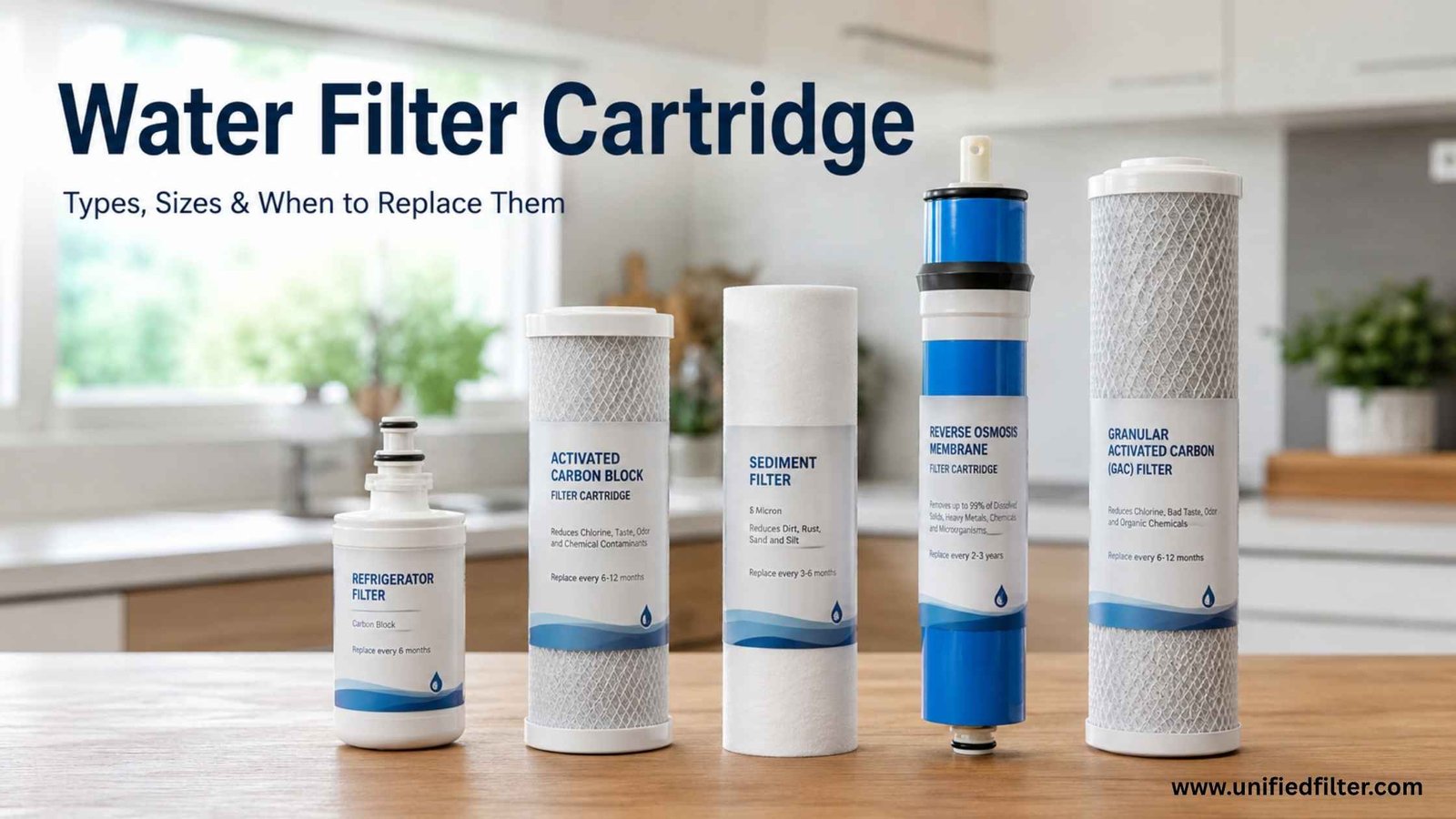

Every water filter you will ever buy for your home comes down to one object: a cartridge. It sits inside your fridge, your pitcher, your faucet mount or the housing under your sink, quietly doing the actual work while the appliance around it just routes water through it. Yet most people only look at a cartridge twice — out of the box, and out of the fridge, grey and overdue. This guide opens the cartridge up, in words: what it is made of, why it is sealed and rated, how to read its label, and why two cartridges that look identical can be completely different parts.
What a Cartridge Actually Is
Strip it down and a cartridge has two parts: a housing and the media inside it. The housing is the rigid shell — on a fridge cartridge, a moulded plastic body shaped to lock into one specific filter head, with seals that keep water flowing through the media instead of around it. The media is the working material packed inside: the substance that actually treats the water as it passes.
That split explains almost everything else. The housing decides where the cartridge fits; the media decides what the cartridge does. Two cartridges can share a media type and still be different parts, because their housings, seals and connections differ — and a cartridge can fit perfectly while doing less than you think, if its media was never tested for the claims on its box. Fit and performance are separate questions, and a good buyer checks both.
The Media Types, in Plain Terms
Four media families cover nearly every home cartridge you will meet:
| Media type | What it is | Its main job |
|---|---|---|
| Carbon block | Activated carbon compressed with a binder into a solid block | Chlorine taste and odour, plus certified reductions for specific contaminants on tested models; the block also strains fine particles |
| Granular activated carbon (GAC) | Loose granules of activated carbon in a shell | Taste and odour improvement, mainly chlorine; the workhorse of pitchers and faucet mounts |
| Sediment media | Pleated, spun or wound material that works like a fine net | Sand, rust and visible particles; protects finer stages downstream |
| Membrane | A very fine sheet water is forced through, as in reverse osmosis | Dissolved solids and a much wider contaminant range; a different technology class from carbon |
Carbon is the one you will see most, and our guide to activated carbon water filters explains how it captures contaminants by adsorption. The table’s point is simpler: “filter” is not one thing. A sediment cartridge and a carbon block do almost unrelated jobs. Reading a label starts with knowing which job you are buying.
Why Cartridges Are Sealed, Rated Consumables
A cartridge is not a permanent part you clean and reuse. It is a consumable with a rated life, and the rating has two halves: a volume (gallons) and a time (months). Whichever arrives first ends the cartridge’s certified life.
The volume half exists because media capacity is finite: carbon captures contaminants on its surfaces, and as those surfaces fill, performance falls away. The time half exists because a wet cartridge sitting in a fridge for a year is not the same object it was in month two, whatever the gallon count says. Both limits are real, and when the rating ends, the certification behind the cartridge’s claims ends with it. The cartridge may still pass water; it is no longer the tested product.
This is also why cartridges are sealed. The media inside is a tested system — its density, flow path and contact time were part of what earned the certification. An opened or refilled cartridge is, by definition, no longer the thing that was tested. Sealed is not a marketing trick; it is how the rating survives from the factory to your fridge.
How to Read a Cartridge Label and Spec Sheet
A cartridge’s label and product page carry the same handful of fields. Read them in this order:
- Standards and certifications. Look for named standards — NSF/ANSI 42 (taste, odour, chlorine), 53 (health-related contaminants such as lead), 401 (emerging compounds such as certain pharmaceuticals) — noting that certification belongs to the exact model tested, not the brand generally.
- Rated life. Gallons and months, as above. A cartridge with no stated life is making no promise.
- Flow rate. In gallons per minute: how the cartridge was tested, and whether it suits the fixture it feeds.
- Replaces / fits numbers. The part numbers the cartridge stands in for — the compatibility contract. Match your old cartridge’s number against it.
- Media. The field naming what is actually inside — carbon block, GAC, and so on.
Our finder guide, what water filter do I need, walks through matching those numbers to your fridge step by step.
A Worked Example: Reading the EDR1RXD1
Take the genuine EveryDrop Filter 1, the EDR1RXD1, and read its page by the checklist. Media: Carbon Block (primary media: Activated Carbon Block). Certifications: NSF/ANSI Standards 42, 53 and 401, plus CSA B483.1, with a specification listing it as certified to reduce up to 70 contaminants and microplastics reduction certified at 99%. Rated life: 200 gallons or 6 months. Flow rate: 0.5 GPM, typical for the model. Replaces list: W10295370A, W10790813 and Kenmore 9081, among others. And its replacement instructions include flushing about 4 gallons through the new cartridge before drinking — the standard clearing step for a fresh carbon block.
Every field on that page does one of the checklist’s jobs: media, standards, life, flow, replaces-numbers, and the flush that starts the rated life properly. At Discounted Filter Store the genuine EDR1RXD1 is $39.99 one-time with free US shipping on any order amount — against $59.99 at the official store, or $48 on its subscription. Orders are processed in 1–2 business days, delivered in 3–5 business days via USPS, and returns are free within 30 days with a prepaid label.
Why Look-Alike Cartridges Are Not Interchangeable
If the housing decides fit, then shape is destiny. Fridge filter heads differ by brand and generation: length, diameter, locking lugs, connector style and seal placement are all model-specific. A cartridge a few millimetres off may refuse to seat, may seat and leak, or — worst of all — may seat while letting water bypass the media entirely, so the fridge reports a filter installed while nothing is filtered.
Certification is per-model for the same reason: the tested cartridge is a specific housing, media fill and seal arrangement under a specific part number. A look-alike has its own — usually unstated — test history. “Fits the same fridges” is a claim about geometry; it says nothing about what the cartridge does. Buy on the part number your fridge names, and on certification you can read, not on resemblance.
Storing Spares, and Disposing of the Old One
Spares are worth keeping — a cartridge changed on time beats one changed eventually — and storage is simple: sealed packaging, indoors, a cool dry place away from strong smells and chemicals, oldest used first. A sealed cartridge is not ageing like an installed one, because the rated life counts gallons through it and months in service; still, check very old stock and its part number before installing, and treat the manufacturer’s guidance as final.
Disposal is equally plain: a spent household cartridge generally goes out with normal household waste in most places, since what it captured stays bound in the media — but local rules vary, and some makers run take-back schemes, so check your local waste guidance. What a spent cartridge should not do is go back into service “for a bit longer”. Its rating was the promise; once spent, it is spent.
Frequently Asked Questions
What is the difference between a filter cartridge and a filter? The cartridge is the replaceable filtering unit itself — housing plus media — while “the filter” usually means the whole arrangement: cartridge, housing or head, and the appliance it serves. When you buy a replacement, you are buying a cartridge.
Can I wash or refill a fridge filter cartridge to extend its life? No. Cartridges are sealed because the media fill and flow path are part of the tested product. Opening or refilling one destroys the arrangement the certification was based on, and no home method restores spent carbon’s capacity.
Which matters more, the gallon rating or the month rating? Both are real limits, and certified life ends at whichever you reach first. Light dispenser use hits the month limit first; heavy use may exhaust the gallons sooner.
My new cartridge looks identical to a cheaper one. Are they the same? Not necessarily. Appearance shows the housing’s rough shape, not the media fill, seal quality or certification. Compare part numbers and named standards, not colours and silhouettes.
What does the flush after installing actually do? It clears air and loose carbon fines and settles the media before you drink from it. The EDR1RXD1’s page, for example, specifies about 4 gallons; your own cartridge’s instructions are the authority for its number.
How should I store a spare cartridge? Sealed in its packaging, indoors, cool and dry, away from strong odours and chemicals — and rotate stock so the oldest spare goes in first. Check very old spares against the manufacturer’s guidance before use.