
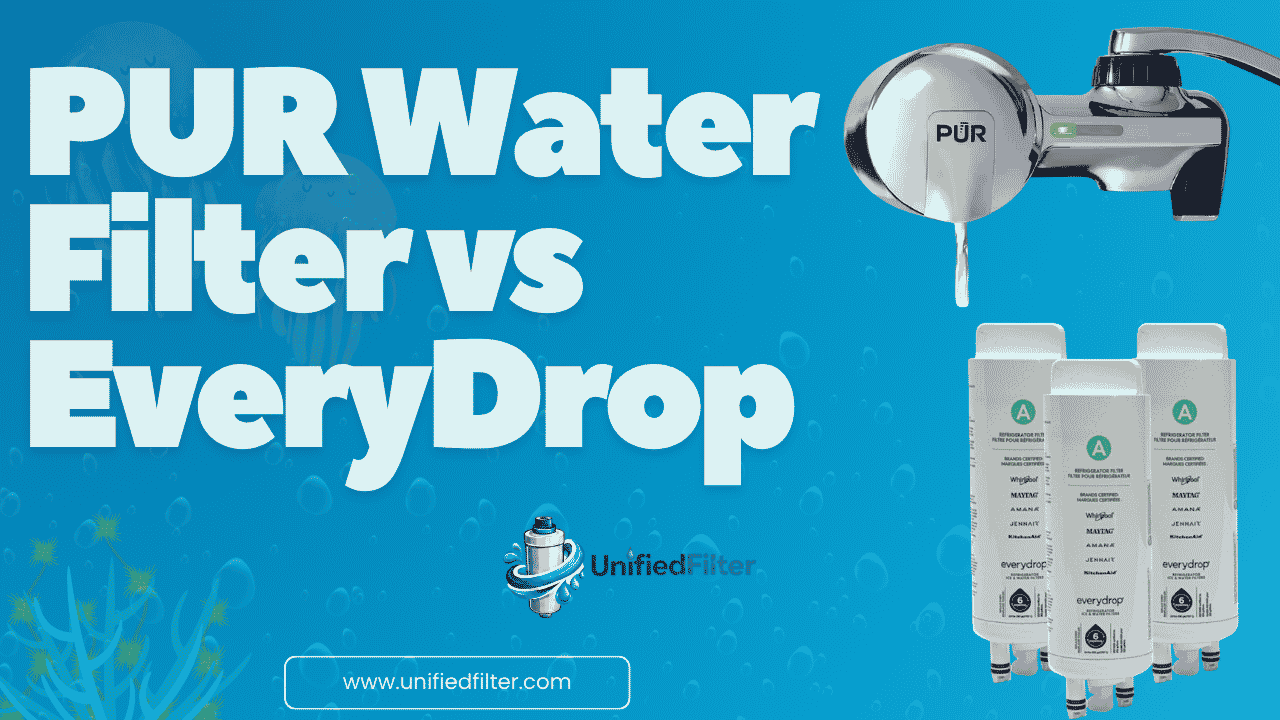

Some brands get searched on our store because shoppers assume every water filter brand sells every kind of filter. PUR is one of those searches. So, plainly and up front: we do not sell PUR products, and nothing in this guide is for sale here. PUR is a filtration brand known mainly for two things — filters that mount directly onto a kitchen faucet, and filter pitchers. We sell genuine refrigerator water filter cartridges. Those are different worlds that happen to share the words “water filter”, and this page explains PUR’s world honestly: what the brand sells, how the faucet-mount category actually works, and the checks that judge any faucet or pitcher cartridge — checks that matter more than the logo on the box.
What PUR Sells, by Category
Stated generally, because the specific lineup changes over time and each model’s own documentation is the authority for it: PUR’s range is built around faucet-mount filtration systems — a housing that attaches at the end of the kitchen tap, with a replaceable cartridge inside and, on many faucet filters across the category, a bypass so you can switch between filtered and unfiltered water — and filter pitchers and dispensers, the fill-and-pour format our water filter pitcher guide covers as a category. Replacement cartridges for both formats are the ongoing purchase, as with every filtration format. That is essentially the brand’s territory: the tap, and the jug. Not the fridge, not under the sink, not the main line.
The Faucet-Mount Category, Explained
The faucet mount is the simplest plumbed filter there is. The unit screws onto the faucet’s outlet — usually where the aerator sits — with adapters supplied for common thread types. Turn a lever or dial and water diverts through the cartridge instead of straight out of the tap.
Two category facts deserve plain statement. First, fit: faucet mounts are made for standard faucets. Pull-out and pull-down sprayer faucets — a large share of modern kitchens — generally cannot take them, because the filter needs a fixed, threaded outlet to hang from. Side-sprayers and non-standard designer faucets are also commonly excluded. If your kitchen tap pulls out, this whole category is closed to you no matter the brand, and the pitcher or an under-sink unit is your route. Second, the indicator: many faucet filters in this category carry a filter-change indicator — commonly a small light or dial that tracks use and signals when the cartridge’s rated life is spent. It is a genuinely useful feature in a category where the cartridge is otherwise invisible inside its housing; treat the indicator as the prompt and the maker’s stated life for the exact model as the reference behind it.
The honest category limits follow from size. A faucet cartridge is small and the water passes at tap speed, so contact time is short — the same physics our other guides note for compact formats. Faucet filters are taste-and-odour tools first, with whatever additional certified reductions the specific model’s certification lists. Which brings us to the judging rules.
How to Judge Any Faucet or Pitcher Cartridge
The brand name tells you almost nothing. These checks tell you almost everything:
Certification attaches to the exact model. A cartridge is certified — or not — for named contaminants under named standards, model by model. Some faucet and pitcher cartridges carry health-related claims such as lead reduction; many carry taste-and-odour claims only. Both can wear the same brand. The only version of the claim that counts is the one in that model’s certification listing.
“Tested to” is not “certified to”. Marketing that says a cartridge was tested against a standard’s methods, without certification by an accredited body, has not passed through the listing process that makes a claim checkable. Look for the standard number, the contaminant list, and a listing you could verify.
The rated life is part of the claim. Certified reductions describe a cartridge within its rated life — gallons or months, per its documentation. A faucet cartridge run far past its life is filtered water in name only, whatever the box promised.
Replacement economics are the real price. The unit is bought once; cartridges are bought forever. Price the cartridge, multiply by changes per year, and compare formats on that number — the category’s genuine convenience (no installation, filtered water at the existing tap) is paid for in cartridge rhythm.
PUR’s World and the Fridge’s World Do Not Intersect
Worth saying directly, because the search that brought many readers here assumes otherwise: nothing in the faucet-and-pitcher world fits a refrigerator dispenser, and nothing we sell fits a faucet. A fridge takes one specific internal cartridge — identified by the label on the old one, using the label-first method in our guide to what a water filter for your fridge does — and its performance is defined by that cartridge’s own certification. If your actual problem is fridge water, a faucet filter does not solve it; if your problem is the main kitchen tap in a rental with a standard faucet, a fridge cartridge is equally irrelevant. Choose by the outlet you drink from, not by the brand you recognise.
What We Sell Instead
We sell the fridge end of the story: genuine OEM refrigerator cartridges — EveryDrop, Samsung and Frigidaire — including genuine EveryDrop at $39.99 one-time with free US shipping on any order amount, processed within 1–2 business days, delivered in 3–5 business days via USPS, with free 30-day returns on a prepaid label. If a PUR faucet unit or pitcher is what your kitchen needs, buy it from a seller in that category, judge the exact model by its certification listing and rated life, and it will serve you as well as that category honestly can.
Frequently Asked Questions
Do you sell PUR water filters? No. We sell genuine refrigerator water filter cartridges. PUR products — faucet mounts and pitchers — are sold by general retailers; this guide exists so you can judge them on honest terms.
What does PUR actually make? Generally stated: faucet-mount filtration systems that attach to a standard kitchen tap, filter pitchers and dispensers, and the replacement cartridges for both. The current lineup and each model’s specification are in the maker’s own documentation.
Will a faucet-mount filter fit my kitchen tap? Only if it is a standard faucet with a threaded outlet. Pull-out and pull-down sprayer faucets generally cannot accept faucet mounts, and many designer faucets are excluded too. Check your faucet type before considering the category at all.
Is a PUR filter certified to reduce lead? It depends on the exact model — that is the only honest answer. Some cartridges in the faucet and pitcher categories carry certified lead-reduction claims; others are certified for taste and odour only. Read the specific model’s certification listing, not the brand’s general reputation.
Does a faucet filter replace a fridge filter? No. They treat different outlets. A faucet mount filters water at the kitchen tap; a fridge dispenser runs through the fridge’s own internal cartridge. One cannot do the other’s job, and neither’s cartridges fit the other’s housing.
How long does a faucet filter cartridge last? For the interval its maker states for that exact model — faucet cartridges in this category are rated on a months-or-gallons basis, and many units carry a change indicator to track it. The certified claims describe a cartridge within that rated life.