
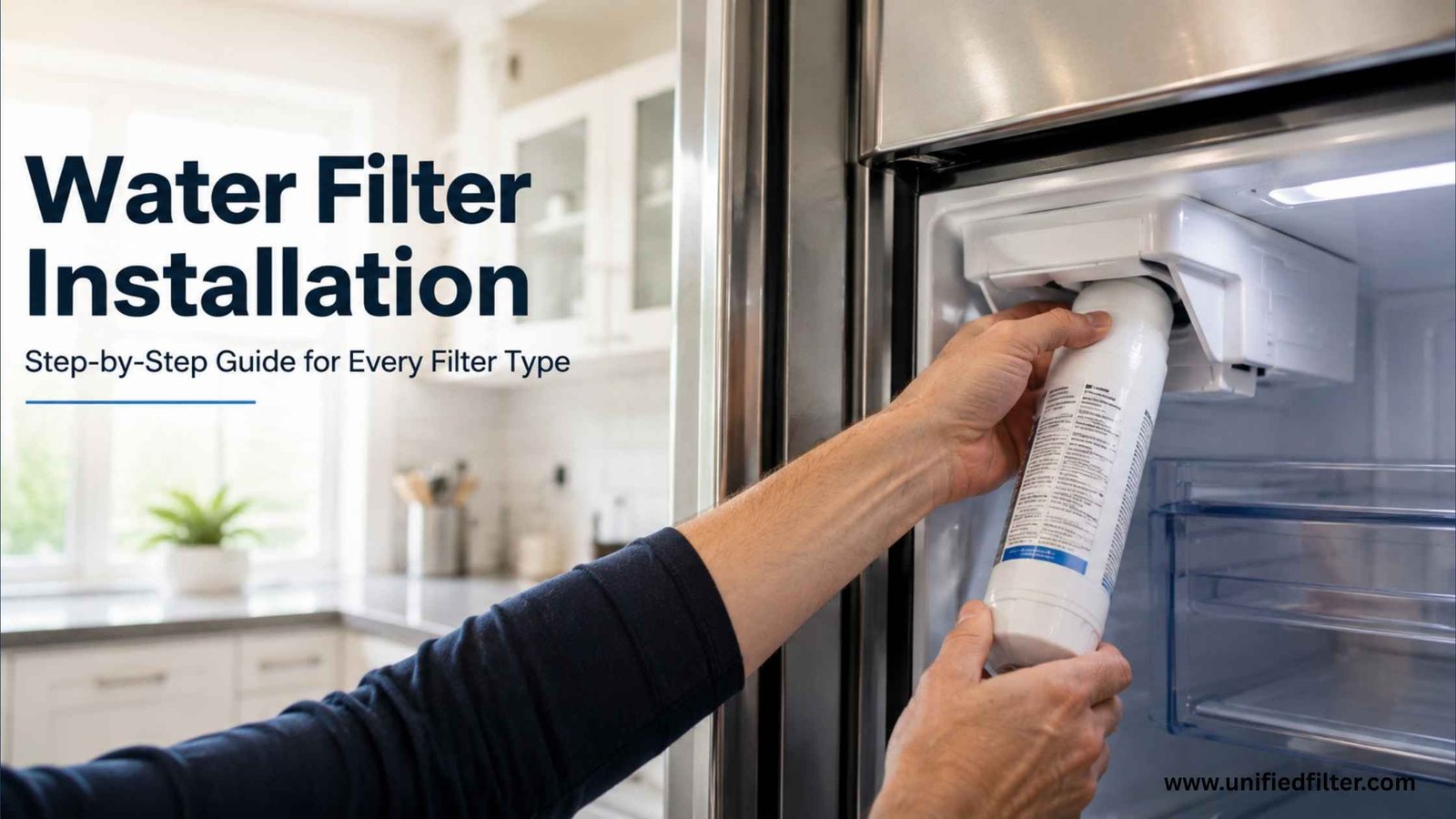
Water Filter Installation, Honestly: What’s a 5-Minute Job and What Needs a Plumber

“Installing a water filter” sounds like one job. It is actually four different jobs wearing the same name, ranging from a task a child could do in two minutes to work that involves cutting into your home’s main water line. Advice that lumps them together — “installation is easy!” — is how people end up under a sink at midnight with a bucket. This guide separates the jobs honestly: what each type of installation really involves, what tools and time it takes, where confident DIY ends, and the mistakes that cause most of the leaks and disappointments along the way. Where a detail depends on your specific model, your manual is the final authority — this guide tells you which questions to ask it.
Fridge Cartridges: Tool-Free, Minutes, Genuinely Easy
The refrigerator cartridge is the friendliest installation in the water world. No tools, no shut-off valve, no plumbing — the filter head inside the fridge is designed for hand operation, and a swap takes minutes. Our full walkthrough, refrigerator water filter replacement, covers the process step by step, and the per-housing guide to how to change a Whirlpool water filter shows how the common housing styles differ.
Underneath the model variations, the pattern is universal:
- Locate the cartridge — commonly in the upper corner of the fresh-food compartment, behind a push-button cover in the grille at the base, or in a drawer-style housing, depending on the fridge.
- Remove the old cartridge — a quarter-turn, a straight pull, or a release button, per your housing’s design.
- Seat the new cartridge fully — push or turn until it stops and locks; a cartridge that is nearly in is effectively out.
- Flush — run the maker’s stated amount of water through the dispenser (the genuine EveryDrop Filter 1’s page, for instance, specifies about 4 gallons) to clear air and carbon fines.
- Reset the filter indicator, so the fridge’s reminder counts the new cartridge’s life, not the old one’s.
That is the whole job. If a fridge cartridge resists, the answer is almost never force — it is re-reading which housing style you have.
Faucet Mounts and Pitchers: No Tools, Minutes
The other genuinely easy category. A pitcher has no installation at all in the plumbing sense: rinse or soak the new cartridge if the maker asks for it, seat it in the reservoir, fill, and discard the first fill or two if instructed. A faucet mount screws onto the faucet’s aerator threads by hand — remove the aerator, fit the adapter if your faucet needs one, tighten by hand, and run water briefly before drinking. Both are minutes-scale, tool-free for most households, and fully reversible. Their limits are about capacity and flow, not installation: they treat drinking water only, one glass or one tap at a time.
Under-Sink Systems: Basic DIY for the Handy
Under-sink filtration is the honest middle ground. A typical install involves mounting the unit inside the cabinet, tapping into the cold-water line at the shut-off valve with a feed adapter or saddle fitting, connecting tubing to the filter and (for dedicated-faucet models) drilling or using an existing hole for the small separate tap, then flushing and checking every joint for leaks. For someone comfortable with a wrench, a drill and Teflon tape, this is generally an hour-scale job. For someone who has never touched a fitting, it is the category where “basic DIY” quietly becomes “call someone” — and there is no shame in that line. If your shut-off valve is corroded, seized or absent, stop there: the valve itself is plumber work, and the filter depends on it.
Whole-House and RO: Plumber Territory for Most Households
Two categories cross the line into professional work for most homes, and it is better to say so plainly than to sell false confidence.
A whole-house (point-of-entry) system installs on the main line where water enters the home. That means shutting off and draining the supply, cutting into the main pipe, fitting the housings in the correct flow direction with bypass valves so the home is never without water during servicing, and pressure-testing the result. A leak here is not a drip under a sink; it is the whole supply, under full pressure, all the time. Local rules vary and permits or licensed-plumber requirements may apply in some places — check yours before assuming a weekend project.
A reverse-osmosis system usually lives under the sink, but adds two complications: a drain connection for the reject water, and a pressurised storage tank with several tubing runs that must each be right. Experienced DIYers do install RO; honestly, it sits at the top of the DIY range, and the drain saddle and tank plumbing are exactly where first-timers leak. If the plan involves modifying drain plumbing you do not fully understand, that is the plumber signal.
The Difficulty Table
| System type | Tools needed? | Typical time | Honest verdict |
|---|---|---|---|
| Fridge cartridge | None — hand operation | Minutes | DIY for everyone |
| Pitcher | None | Minutes (plus any maker-specified soak) | DIY for everyone |
| Faucet mount | None for most faucets; adapter included for many | Minutes | DIY for everyone |
| Under-sink filter | Basic hand tools — wrench, drill for a dedicated tap | Around an hour-scale job | DIY for the handy; pro if fittings are unfamiliar |
| Reverse osmosis (under-sink) | Basic hand tools plus drain-saddle fitting | A few hours for a first-timer, in general terms | Advanced DIY or pro |
| Whole-house / point-of-entry | Pipe cutting and fitting tools, main shut-off work | Half-day scale, plus pressure testing | Plumber for most households |
The Mistakes That Cause Most Problems
- The unseated cartridge. A fridge or housing cartridge pushed almost home leaves a gap at the seal — water bypasses the media or weeps past it. Seat until it locks or stops solidly, every time.
- The skipped flush. New carbon media sheds fines and holds air. Drinking the first glass unflushed gives you grey, fizzy, odd-tasting water and a false verdict on a good filter. Flush what the maker specifies.
- The backwards cartridge. Where a cartridge or housing has a flow direction — under-sink and whole-house housings especially — installing it reversed defeats the media arrangement and can choke flow. Check the direction markings before the water goes back on.
- The overtightened housing. Sump housings seal on an O-ring, not on force. Cranking them down with everything you have distorts seals and makes the next change a wrestling match; hand-tight plus the maker’s specified snug is the pattern. (We give no torque numbers — your housing’s manual owns those.)
- The un-checked joint. Every pressurised connection you touched should be watched, dry-paper-towel in hand, for the first minutes under pressure. Most install leaks announce themselves immediately and politely — if someone is looking.
Frequently Asked Questions
Do I need to turn off the water supply to change a fridge filter? For most fridge cartridges, no — the filter head is designed for a tool-free swap with the supply live, and the fridge’s own documentation for models like those using the EDR1RXD1 describes a twist-in change with no tools. Your fridge manual is the authority for your model.
How long does it take to install an under-sink water filter? In general terms, around an hour for someone handy with basic tools, longer for a first attempt. Dedicated-faucet models add the tap fitting; inline models that feed the existing faucet are usually simpler.
Can I install a whole-house filter myself? It is possible for an experienced DIYer with pipe-fitting skills, but it means cutting into the main line, adding a bypass, and pressure-testing — and local rules may require permits or a licensed plumber. For most households we say plainly: hire the plumber.
Why does my water taste strange right after installing a new filter? Usually a skipped or short flush: new carbon sheds fines and the cartridge holds air. Run the maker’s stated flush amount through and let the system settle; if the taste persists well beyond that, re-check that the cartridge is fully seated.
What is the most common cause of leaks after installation? An unseated cartridge or a disturbed O-ring at a housing seal — followed by fittings tightened by guesswork. Re-seat, inspect the ring for nicks or grit, and re-tighten to the maker’s specification rather than maximum force.
Does Discounted Filter Store sell under-sink or whole-house systems? Our store specialises in refrigerator filter cartridges — genuine EveryDrop, Samsung and Frigidaire lines — with free US shipping on any order, processing in 1–2 business days and delivery in 3–5 business days via USPS. This guide covers other system types honestly so you can plan the whole house, but we do not sell those systems.