
Search for “filtered water dispenser” and you will be shown three different machines wearing one name — and much of the disappointment in this category comes from buying one kind while imagining another. There is the dispenser built into your refrigerator door. There are countertop and cooler-style units. And there are small dedicated taps fed by a filter under the sink. Each filters differently, holds a different amount, and asks a different amount of plumbing. This guide separates them honestly, compares them on the things that actually differ, and ends with the checks to run before buying any of them — including the one most listings would rather you skipped: asking what, exactly, does the filtering. Our own shelf is the first kind — we sell the cartridges that feed fridge dispensers — so that section carries our real prices; the other two kinds we do not sell, and carry none.
Type 1: The Refrigerator’s Built-In Dispenser
The dispenser in a fridge door is a filtered water dispenser in the most literal sense: household water passes through the refrigerator’s internal cartridge and comes out the door, chilled, on demand. On most models with an ice maker, the same cartridge also feeds the ice — one filter quietly serving both. Capacity is effectively unlimited while the tap runs; there is no reservoir to refill, because the mains is the reservoir.
The filtration is the cartridge’s, which makes the cartridge the whole story. A genuine certified one — the EveryDrop Filter 1, EDR1RXD1, certified to CSA B483.1 and NSF/ANSI Standards 42, 53 and 401 per its product page — does certified drinking-water work at the glass. An exhausted or no-name cartridge in the same door makes the dispenser a chilled-water tap with a decoration inside. Maintenance is a cartridge swap on roughly a six-month rhythm (the Filter 1 page rates it at 6 months and 200 gallons). Our water filter for a fridge guide covers this route end to end.
Type 2: Countertop Units and Water Coolers
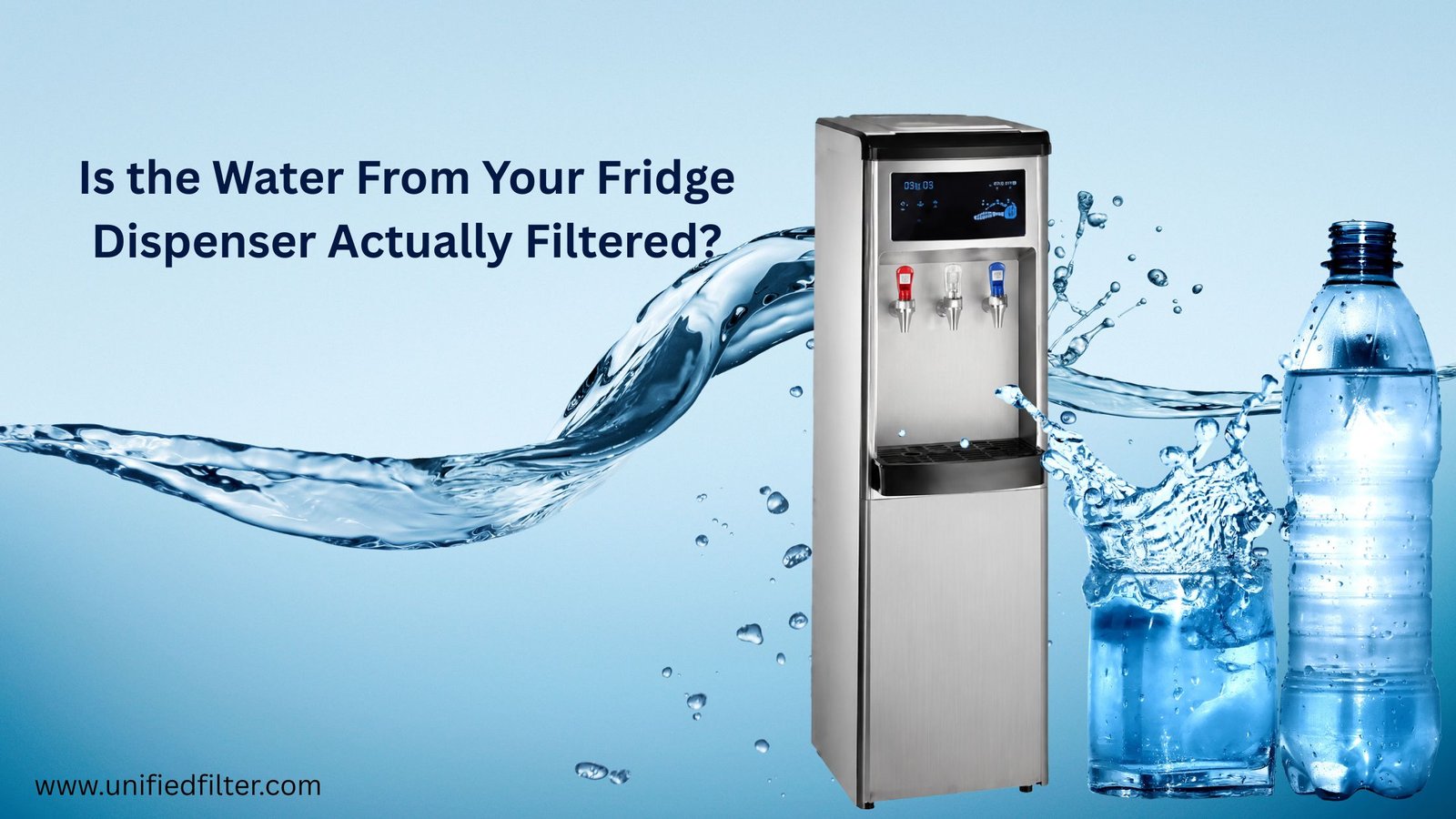
The second kind stands alone: countertop dispenser units and floor-standing coolers. Here the honest split matters most, because this family contains two genuinely different machines.
Some countertop units filter tap water themselves — you fill or plumb them, an internal cartridge does the work, and the unit chills (and sometimes heats) the result. Others — the classic office cooler is the type specimen — do not filter at all: they dispense bottled water, and whatever filtration happened took place at the bottler’s plant, not in your kitchen. Neither is a scam; they are different products. But if your reason for buying is filtration you control — a cartridge you chose, changed on your schedule — the bottled cooler does not provide it, and bottle supply becomes your recurring errand instead.
Type 3: The Dedicated Dispensing Tap
The third kind hides its machinery: a filter unit under the kitchen sink feeding a small, separate tap at the counter. Fill a glass at the main tap and you get ordinary water; fill it at the little tap and you get the filtered line. Some of these systems are carbon; some are reverse osmosis, which adds a storage tank and a drain connection. Capacity is strong — the mains again, through a filter sized for one outlet — and the countertop stays clean, which is the design’s appeal. The costs are installation and invisible maintenance: an under-sink cartridge is easy to forget precisely because you never see it, so its change date needs a calendar, not a memory.
The Three Kinds, Compared
| Fridge dispenser | Countertop / cooler unit | Dedicated dispensing tap | |
|---|---|---|---|
| How the water is filtered | The fridge’s internal cartridge, at the door | Varies: internal cartridge in filtering models; bottled units do not filter in your home at all | Under-sink unit (carbon, or RO with a tank) feeding a small tap |
| Capacity | Continuous from the mains; also feeds the ice maker on most models | The unit’s reservoir or bottle; refills or bottle swaps are part of ownership | Continuous from the mains, at that one tap |
| Plumbing needed | None beyond the fridge’s own water line | None for countertop/bottled; plumbed models need a line | Yes — under-sink installation and a tap fitting |
| Maintenance rhythm | Cartridge swap about every 6 months | Cartridge changes on filtering models; bottle supply on coolers | Cartridge changes on a months-scale cycle; RO membranes on a longer one |
| Counter/floor space | None — it is the fridge door | A countertop footprint, or a floor corner plus bottle storage | None on the counter; cupboard space under the sink |
Who Each Kind Suits
The fridge dispenser suits a household whose fridge already has one — which is more kitchens than not — and wants filtered water and ice with zero new furniture. The only real work is keeping a genuine cartridge in it. A countertop or cooler unit suits a space with no dispenser fridge and no appetite for plumbing: a rented flat, an office, a workshop — accepting either the cartridge routine of a filtering model or the bottle routine of a cooler, knowingly. The dedicated tap suits a homeowner who wants filtered water at the sink in volume — filling pots, not just glasses — and will trade an installation afternoon for an invisible, always-ready tap.
And one neighbouring option worth naming: the filter pitcher — the simplest dispenser of all, a jug that filters as you pour — treated with the same honesty in our water filter pitcher guide, limits included.
Before You Buy Any Dispenser: The Checks
- What actually filters the water? In the unit, at the bottler, or not at all? Get the answer in the specifications, not the product name — “dispenser” describes delivery, not filtration.
- What is the filter certified to do? Look for NSF/ANSI standards named against the exact cartridge — Standard 42 for taste and odour, 53 for health contaminants such as lead, 401 for pharmaceutical-class compounds. A brand’s general reputation certifies nothing; listings attach to specific cartridges.
- Can you get replacement cartridges, and how often are they due? A dispenser is a subscription to its own cartridge. Check availability and the stated replacement rhythm before the unit arrives, not after the light turns red.
- What does the routine honestly look like in your home? Refilling reservoirs, swapping bottles, or remembering an invisible under-sink cartridge — pick the chore you will actually keep doing.
The Route We Can Sell You
If your kitchen’s answer is the fridge door — as it already is in a large share of homes — the consumable is the cartridge, and ours are genuine: the EveryDrop Filter 1 is $39.99 one-time at Discounted Filter Store with free US shipping on any order amount, against the official store’s $59.99 one-time or $48 by subscription, Filters Fast’s free shipping only at $99+, and Discount Filter’s at $70+. Orders are processed within 1–2 business days, delivered in 3–5 business days via USPS, and returns are free within 30 days with a prepaid label. For the other two kinds, buy from their specialists — armed with the checks above.
Frequently Asked Questions
Is a fridge door dispenser really a filtered water dispenser? Yes — the most literal kind: water passes through the fridge’s internal cartridge immediately before dispensing, chilled and on demand. Its filtration quality is exactly its cartridge’s quality, which is why a genuine, certified cartridge matters.
Do water coolers filter the water? Generally, no. A classic bottled cooler dispenses water that was treated at the bottler’s plant; the unit itself chills and pours. Countertop models with their own cartridges do exist — the specification sheet, not the category name, tells you which kind you are looking at.
Which type holds the most water? The plumbed kinds, effectively: a fridge dispenser and a dedicated tap both draw continuously from the mains, so their limit is the filter’s capacity over its life, not a tank. Countertop and cooler units hold a reservoir or a bottle, and refilling is part of ownership.
What should I check before buying a dispenser unit? Four things: what actually performs the filtration, the NSF/ANSI standards certified for its exact cartridge, whether replacement cartridges are easy to get and how often they are due, and whether its maintenance routine fits your household honestly.
How often does a fridge dispenser’s filter need changing? About every 6 months for most cartridges — the genuine EveryDrop Filter 1 is rated 6 months and 200 gallons on its product page. Taste returning or flow slowing at the dispenser means the date has arrived early.
Can a dedicated tap system be reverse osmosis? Yes — the under-sink unit behind a dispensing tap can be carbon or RO. RO adds a storage tank and a drain connection, and reduces TDS, which carbon does not — choose it only if TDS is actually your problem.